- The now-extinct Steller's sea cow impacted North Pacific kelp forests by browsing on the surface, encouraging the growth and strengthening of the algal understory, a new study finds.
- The study's researchers say that not only would these sirenians have had a positive impact on kelp forests in the past, but they may also have increased their resilience in modern times.
- Globally, kelp forests face many threats, including warming oceans, which may lead to an overabundance of urchins, known predators.
- The authors suggest that it may be possible for humans to mimic the impact of Steller's rhizomes on the canopy of kelp forests in order to increase their resilience.
- During a Russian-led expedition to the North Pacific Ocean in 1740, German botanist Georg Wilhelm Steller laid eyes on a species that captured his imagination. It resembled a manatee and was larger than an orca, and grazed similarly to a cow or horse. After Steller described the animal, it became known as Steller's sea cow ( Hydrodamalis gigas ).
- Although Steller's ray could reach 9 meters in length and weigh 10 tons, this colossal creature had few defenses. Covered in a thick blubber , Steller's ray could not fully submerge in the water, but floated on the surface, feeding on kelp. This made it particularly vulnerable to hunting.
- "These animals are very voracious and eat incessantly, and because they are so greedy they always keep their heads under water, without any regard for their life or safety," Steller writes in one account . "A man in a boat, or swimming, can therefore move among them without any danger, and freely choose the member of the herd he wishes to attack—and all this while they are feeding."
- By 1768, less than three decades after Steller's formal description of the species, Ritina had become extinct. But in a new publication, some scientists suggest that the species left a significant legacy in the coastal waters of the North Pacific, strengthening kelp forests thanks to its feeding habits.

“The Ritina Effect”
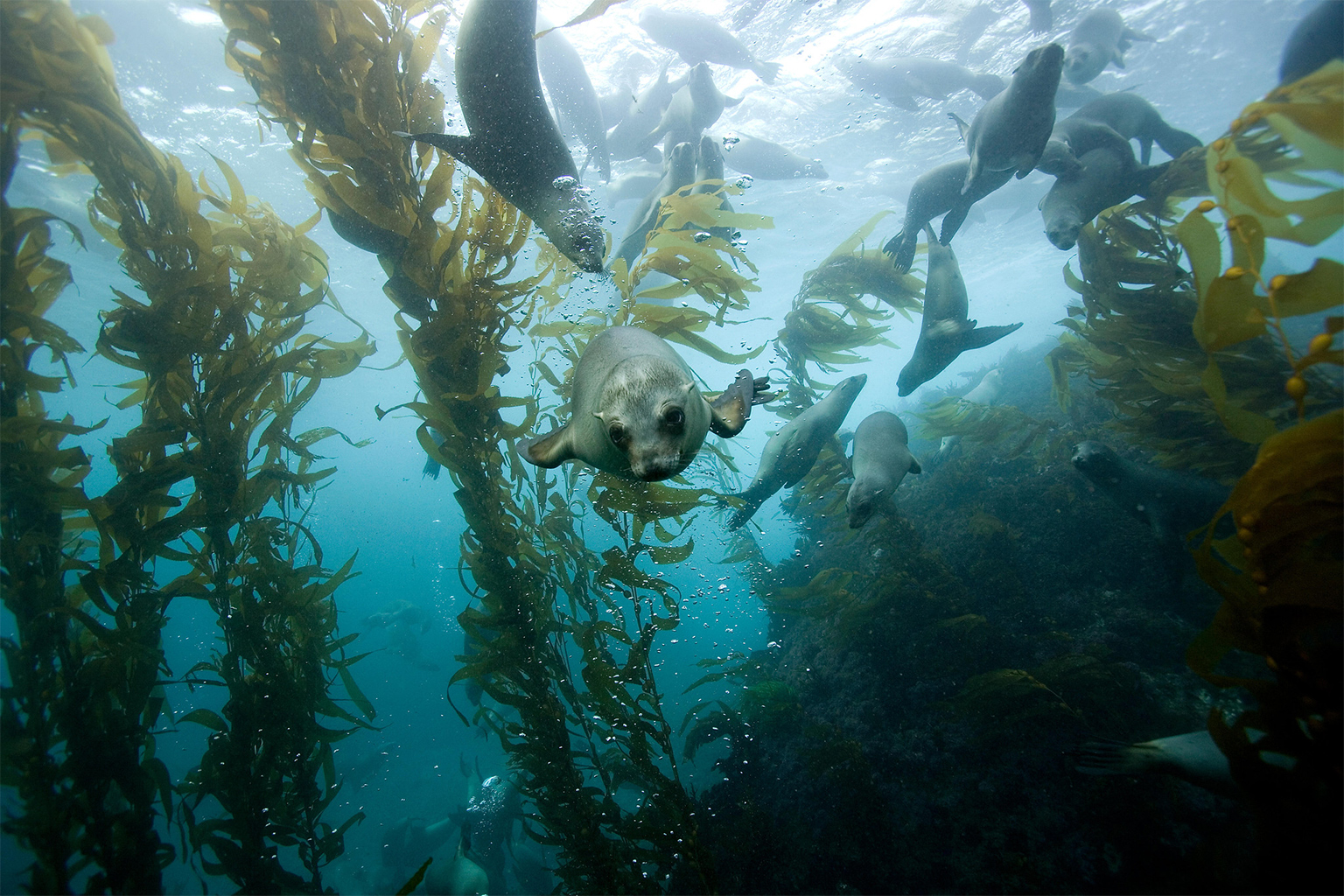
From Baja California to southeast Alaska, giant kelp forests emerge from the seabed along the coast. Under ideal conditions, giant kelp ( Macrocystis pyrifera ) can grow up to 60 centimeters a day, making it one of the fastest-growing species in the world. Although the average length of giant kelp is 30 meters, this species can grow up to 53 meters, about half the length of a football field.
These vast underwater forests provide multiple benefits: food and habitat for thousands of species, water oxygenation that helps reduce ocean acidification , and coastal protection from waves and storm surges, which, due to human-induced climate change, are becoming increasingly intense and frequent.
Globally, however, kelp forests are threatened by rising temperatures , overfishing, pollution and other human activities.
In their paper , the scientists argue that Steller's kelp impacted kelp forests in the North Pacific by grazing their surface, which would have promoted the growth and strengthening of several species belonging to the algal understory. These rich, dense algae would provide a food source for predatory urchins capable of devouring the kelp, transforming the ecosystem into what is known as "urchin barrens." In California, for example, an estimated 95% of the kelp has recently disappeared, primarily due to predation by urchins.

"Elephants have a huge effect on forests because they can clear so much space and vegetation in an extremely short period of time," lead author Peter Roopnarine, a paleontologist and global change researcher at the California Academy of Sciences, told Mongabay, comparing them to Steller's kelp forests. "They open up the forest canopies and these large patches form, and then the community changes completely until large trees re-grow. So the question was very simple: did kelp forests have a similar effect?"
According to Roopnarine and the study's two co-authors, the answer is yes.
Using mathematical models, the researchers hypothesized that kelp forests browsed by Ritinas have likely acquired more robust defenses against stressors—not only in the past but also in the present. The authors dubbed this impact the "Ritina effect."
One of the biggest threats to kelp forests today is marine heatwaves, such as the one that hit the North Pacific in 2013, known as the "Blob," which can lead to an influx of sea urchins. Endangered species such as the sunflower starfish ( Pycnopodia helianthoides ) and threatened species such as the sea otter ( Enhydra lutris ) can contribute to reducing urchin numbers within a kelp forest community. However, these species are not always present in kelp forests due to stressors such as pollution, hunting, and disease. For sea stars, one of the biggest threats to their survival is sea star wasting disease , an infectious disease that rapidly kills sea stars and which scientists believe is exacerbated by climate change.
According to the authors, when kelp forests faced adverse conditions, Steller's rhizomes were able to help the kelp recover quickly. But, the researchers say, the effect would have been even more significant when the kelp forests hosted both rhizomes and otters.
“There are many examples of species that ecologists have realized have a really outsized role in maintaining… an ecosystem,” co-author Roxanne Banker, a research associate at the California Academy of Sciences, told Mongabay. “A classic example is the wolves in Yellowstone, because they control deer populations, modifying the watershed ecosystem. I think this happens a lot among large vertebrates, because they can eat a lot of things.”

There are no more intact ecosystems
According to Max Castorani, a marine ecologist at the University of Virginia – who was not involved in this study – this new research provides an interesting perspective on how kelp forest ecosystems functioned in the past when Steller's reefs were present, but he also added that this implicates many assumptions.
"Within the diverse community of kelp forest ecologists, you'll likely find people who will question some of the assumptions made in the study," Castorani told Mongabay. "But... it's not easy to create these types of models and not be criticized for the assumptions you make."
Castorani added: "I thought it was an interesting study. In general, in ecology, there isn't much emphasis on the paleo perspective, the in-depth historical perspective on how ecosystems may have functioned in the past, and [in this case] it's an interesting way to think about how... kelp forests may have functioned with these Steller's Rhythms that are now extinct."
Mark Carr, a professor of marine ecology at the University of California, Santa Cruz, who was also not involved in the study, noted that the research in question advanced several hypotheses that could not be tested empirically, but emphasized that the extensive modeling employed by the authors was the "real strength of the study." Furthermore, he added, the research contains "several very interesting implications for our understanding of species interactions and kelp forest dynamics, as well as considerations for potential management interventions."

"I think these studies that conduct retrospective analyses of historical natural ecosystems (prior to human alteration) are very interesting and useful because they give us insight into the long history of how humans have altered these systems, and reflect on the implications for how we manage ecosystems today," Carr wrote to Mongabay in an email. "As the authors mentioned, we are always subject to ' sliding baselines ' that limit our understanding of systems and the scope of our management actions relative to more recent observations of altered systems."
The authors of the new study propose evaluating an ecosystem using a past-present-future approach to avoid sliding baseline syndrome, the idea that environmental changes are measured against reference points in the recent past, weakening everyone's interpretation of how an ecosystem must have looked in the past.
"There are no intact ecosystems left… on Earth," Banker said. "It's therefore really important to understand the historical basis of how these systems functioned and how they got here today to improve our predictive power about how we are affecting them and how they will continue to be affected by climate change."


Can we recreate the impact that Steller's Rhinoceros had on kelp forests?
Roopnarine said that while no animal interacts with kelp forests in the same way that Steller's kelp once did, it may be possible for humans to mimic this species' impact on kelp canopies and use such interventions to improve their resilience.
"If our hypothesis is correct, if our models are correct, then we could artificially recreate some of the Steller's kelp's function by cutting or artificially flaking the kelp in the same way that the kelp would have done, and opening up... more space in the [algal] understory," Roopnarine said. However, he added that such an approach would require a lot of experimental work to be properly implemented.
Carr added that commercial kelp production and harvesting for abalone aquaculture could be a means to achieve the "past role of Steller's reefs." However, he argued that "the devil is in the details," as researchers and managers would need to consider a variety of factors, including how thinning canopies to allow for understory growth might affect other species, such as fish, that use kelp forest canopies as habitat.
“Overall, this is a truly remarkable study,” Carr said, “and has several very interesting implications for our understanding of species interactions and dynamics within kelp forests, as well as for considerations of potential management interventions.”
Post a Comment