Ocean floor mining is risky. Who will pay the price?
- Citizens of countries sponsoring deep-sea mining have written to several governments and the International Seabed Authority, expressing their concerns about the difficulties their nations may face in controlling such ventures and the damage to the ocean they will cause.
- Responsibility is a central issue in the risky and still nascent deep-sea mining industry. The first company to drill into the ocean floor, DeepGreen/The Metals Company, relies on sponsorship from small Pacific island states whose collective GDP accounts for a third of its value.
- According to scientists, mining will likely cause widespread damage, but when it comes to deep-sea mining, the legal definition of environmental damage is still being defined.
Pelenatita Kara travels regularly to Tonga, her Pacific home, to educate fishermen and farmers about deep-sea mining. For many of the people she meets, the term is still unfamiliar. Before Kara began appearing on radio programs, few people knew that their government had sponsored a company to extract minerals from the seabed.
“It’s like telling a Tongan how cold the snow is,” he says. “Inconceivable.”
The Civil Society Forum of Tonga, where Kara works, and several other Pacific organizations have written to several governments and the International Seabed Authority (ISA) to express their concerns that their nations may be responsible for environmental damage in the mineral-rich Clarion-Clipperton Zone, a stretch of ocean between Hawaii and Mexico.
"The Pacific is currently the laboratory for the global deep-sea mining experiment," the groups wrote to the ISA, the UN-affiliated body charged with regulating the nascent industry. As a state sponsoring a deep-sea mining company, Tonga has agreed to assume significant responsibility for this industry, which can threaten barely understood ecosystems. If something were to go wrong, Kara is concerned that Tonga's liabilities could exceed its ability to cover the costs. If no one can pay to repair the damage, Greenpeace emphasizes , it will be even worse.
“My concern is that any liability associated with deep-sea mining is simply too much for us,” Kara says.
Another Pacific island nation, Nauru, notified the ISA in June that a contractor it currently sponsors is applying for the world's first deep-sea mining permits. This news triggered the "two-year rule," which requires the ISA to consider the application within that period, regardless of whether mining rules and regulations are established by then.
Among the rules that may not be decided by the deadline is liability: Who is responsible if something goes wrong? Sponsoring states like Nauru, Tonga, and Kiribati—which sponsor contractors owned by Canada's DeepGreen, now The Metals Company—are required to "ensure compliance" with ISA rules and regulations. If a contractor violates ISA rules, for example by causing greater than expected damage to ocean ecosystems, the contractor can be held liable if the sponsoring state has done everything possible to enforce national laws.
However, it's still unclear how these countries can convince the ISA that they've enforced the rules, nor how they can demonstrate their ability to monitor contractors when the company is foreign-owned. The responsibility of sponsoring states to potentially finance billions of dollars in environmental cleanups hinges on legal definitions of terms like "environmental damage" and "effective control," terms that are as unclear today as they may be in two years.
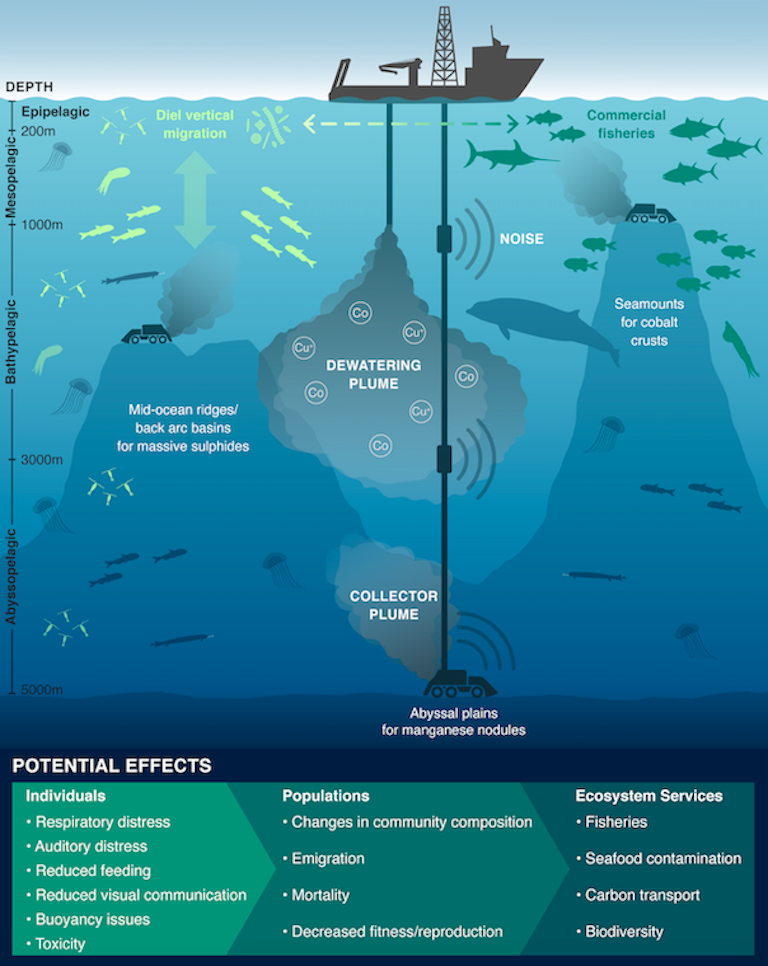
There are myriad problems that could arise in the extraction area: Sediment plumes could travel thousands of kilometers and hinder fishing, or the damage could spread to areas where other companies operate. Scientists don't know all the potential consequences of these activities, as we're dealing with poorly understood ecosystems. The ISA has proposed creating a fund to help cover the costs, but it's unclear who will fund it.
“The scale of the affected areas is so large that environmental restoration is simply not feasible,” says Craig Smith, professor emeritus of oceanography at the University of Hawaii, who has worked with the ISA since its inception in 1994. “Restoring tens or hundreds of thousands of square kilometers would likely be more expensive than the mining operation itself.”

Nauru expresses its concerns
- A little over a decade ago, before Nauru agreed to sponsor a deep-sea mining permit, the government feared it would be liable for any associated damages. The government wrote to the International Tribunal for the Law of the Sea, expressing its concerns about the liability it might incur. As a sponsoring state with no experience in deep-sea mining and a small budget to support it, the delegation wanted to ensure the UN did not prioritize wealthy countries in charting this new frontier of mining. Nauru and other "developing" countries, they argued, should have the same opportunity to benefit from mining as other countries with more experience in capital-intensive projects.
- Sponsor states like Nauru are required to ensure that their contractors comply with the law, but, the delegation wrote, "in reality, no amount of measures taken by a sponsor state could ever 'ensure compliance' of a contractor when the contractor is an entity separate from the state."
- Deep-sea mining entails risks —environmental, financial, commercial, and political—that developing states are required to monitor. According to Nauru's 2010 request, "unfortunately, it is not possible for developing states to fulfill their responsibilities to the same extent as developed states." If the standards of these responsibilities varied according to state capabilities, the Nauru delegation wrote, both poor and rich countries could have their chance to exploit the precious metals locked in the ocean depths.
- “Poorer and less developed states are reportedly expected to do less in terms of oversight because they lack adequate resources and capacity,” explains Don Anton, the court’s legal adviser on behalf of the IUCN, the world conservation authority, during the decision.
- The court disagreed in issuing a final opinion the following year. Every state sponsoring a deep-sea mining company would be required to uphold the same standards of due diligence and "compliance" measures. Legal experts welcomed the decision, as it prevented contractors from seeking sponsorship from states that imposed lower requirements on their operations. However, according to Anton, countries with limited budgets like Nauru faced only two choices when considering deep-sea mining: fully sponsor a contractor or avoid the business altogether.
- According to the court's ruling, "one cannot evade one's responsibilities as a sponsoring state by invoking one's limited financial or administrative capacity," says Isabel Feichtner, a law professor at the University of Würzburg in Germany. "And this naturally raises the question: To what extent can a small developing state really control a contractor that may only have a single office in that state?"
- Nauru had just begun sponsoring a private company to explore for mineral wealth under the sea in the Clarion-Clipperton area. Nauru Ocean Resources Inc. (NORI), initially a subsidiary of Canada's Nautilus Minerals, transferred its ownership to two Nauruan foundations, while Nautilus's founder remained on NORI's board of directors. As a developing nation, Nauru argued that this type of public-private partnership was the only way to engage in mineral exploration.
- on the NORI board of directors. As a developing nation, Nauru asserted that this type of public-private partnership was the only way to engage in mineral exploration and officially agreed to sponsor NORI.
Check
Following the court's decision, the European Union acknowledged that it would be a daunting task to write the world's first deep-sea mining rules to govern companies thousands of miles away from countries with little capacity to conduct exploration.
The EU, whose member states sponsor mineral exploration, began a €4.4 million ($5.1 million) project in 2011 to help Pacific island states develop mining codes. However, by 2018, when most states had finished drafting national regulations, the Pacific Network on Globalization (PANG) noted that these codes "did not sufficiently protect the rights of indigenous peoples or the environment in line with international law." Furthermore, in some cases, countries enacted legislation before civil society actors were aware of the existence of the legislation, said PANG Executive Director Maureen Penjueli.
"In our region, most legislation assumes a very small impact, so there's no reason for broad consultations," he says. "As with most legislation, it only considers where the mining takes place, not where the impacts are felt."
For Kara, mining laws are one thing, but enforcement is another. Under deep-sea mineral exploration rules, sponsoring states must have "effective control" over the companies they sponsor, but the ISA hasn't explicitly defined what this means. For example, the exploration contract for Tonga Offshore Mining Limited (TOML) states that if "control" changes, it must find a new sponsoring state. When DeepGreen acquired TOML in early 2020 after Nautilus filed for bankruptcy, the ISA stated that the Tongan government granted the transfer and there was no need to reassess the company's history.
Kara questions whether Tonga can adequately oversee TOML, its management, and its operations. TOML is registered in Tonga, but its management is made up of Australian and Canadian DeepGreen employees. It is owned by the Canadian company. Since DeepGreen acquired TOML, the company's sole Tongan citizen is no longer listed among its management roles .
"It's not enough to be incorporated into the sponsoring state. The sponsoring state must also be able to control the contractor, and this raises the question of its ability to do so," says Feichtner.
When the Civil Society Forum of Tonga and others wrote to the ISA, they argued that Canada should be the state sponsor of TOML, given that TOML is owned by a Canadian company. In response, the ISA wrote that the Tongan government "has no say" in management changes, and therefore no change was necessary.
"Of all the work they're doing in the area, I don't think there's any Tongan sitting around doing so-called validation and verifying what's being done. We're taking everything at face value," Kara says. With limited resources available to track down people living in Canada or Australia, Kara worries that Tonga won't be able to hold foreign companies accountable for any problems that may arise.
By merging with a US-based company, DeepGreen became The Metals Company and will be accountable to shareholders in the United States. The United States, however, has not signed the UN convention that governs the ISA and, as such, is not bound by the ISA regulations, the sole authority governing deep-sea mining.
"What I think is pretty clear is that 'effective control' means economic control, not regulatory control," explains Duncan Currie, a lawyer who advises conservation groups on ocean law. "Wherever that is, it's not in Tonga."
Risks s
On September 7, the Tongan delegation to the IUCN Global Conservation Summit in France joined 80 percent of government agencies in voting for a motion calling for a moratorium on deep-sea mining until more is known about the impacts and policy implications.
"As a scientist, I'm heartened by their decision," says Douglas McCauley, professor of ocean sciences at the University of California, Santa Barbara. "The passage of this motion recognizes the research done by scientists around the world demonstrating that ocean mining is simply too risky for the planet and for people."
The Tongan government continues to sponsor a mineral exploration permit for TOML. According to the latest information, Tonga and TOML have agreed that the company will pay a $1.25 royalty for each ton of nodules extracted. According to scenarios presented to the ISA by a team from the Massachusetts Institute of Technology, this would amount to just 0.16% of the value of the assets the country sponsors. The royalties paid to the ISA and then distributed to the countries could be approximately $100,000.
Nauru's contract with NORI stipulates that the company is not required to pay income tax. DeepGreen has indicated in its filings with the U.S. Securities and Exchange Commission that royalties will not be finalized until the ISA completes its resource exploitation code. Under the two-year rule, NORI plans to apply for a mining permit regardless of when the code is drafted.
"Nauru's only substantial economic benefit could come from the payment of royalties, which have not yet been specified. If something goes wrong, it potentially incurs this enormous liability," Feichtner explains.
Like NORI, TOML began its operations as a subsidiary of Nautilus Minerals, one of the world's first deep-sea minerals miners. Shortly before Nautilus's project off the coast of Papua New Guinea failed , leaving the country with $157 million in debt, its shareholders created DeepGreen.
"I fear Tonga will be another Papua New Guinea," Kara says. "If they start drilling in the deep ocean and something happens, we won't have the resources or the expertise [to fix things] […] we need to monitor what they're doing."
DeepGreen said it is giving "developing" nations like Tonga the opportunity to benefit from deep-sea mining without assuming the commercial and technical risks. DeepGreen did not respond to Mongabay's requests for comment.
"I'm still trying to understand their point of view. Personally, I think DeepGreen is using Pacific Islanders to promote their image. I still think their target is not us, but the shareholders," Kara says.
Kara doubts that the minerals on the ocean floor are necessary to phase out fossil fuel use. In a letter to a Tongan newspaper, Kara wrote: "Deep-sea mining is a remnant left over from the extractive economic approaches of the 1960s and 1970s. It has no place in the modern world. It doesn't go hand in hand with a sustainable blue economy. As Pacific Islanders already know—and science is just beginning to understand—the deep ocean is connected to shallower waters and coral reefs as well as lagoons. What happens in the deep [ocean] has repercussions everywhere."
Post a Comment