Searching for future-proof marine plants in the acidic waters surrounding a volcano
- Low pH levels in naturally acidic waters near an underwater volcano in Italy, according to worst-case climate forecasts, will become commonplace by the end of the century and beyond.
- Scientists are studying the reactions of local seagrasses and algae to acidic conditions.
- One of the questions scientists are asking is whether seagrasses could be used for environmental restoration in other areas that may become more acidic in the near future.
- However, some researchers warn that these carbon-sequestering marine plants face more imminent threats such as pollution, habitat degradation, and global warming—problems that must be addressed if their restoration efforts are to be effective.
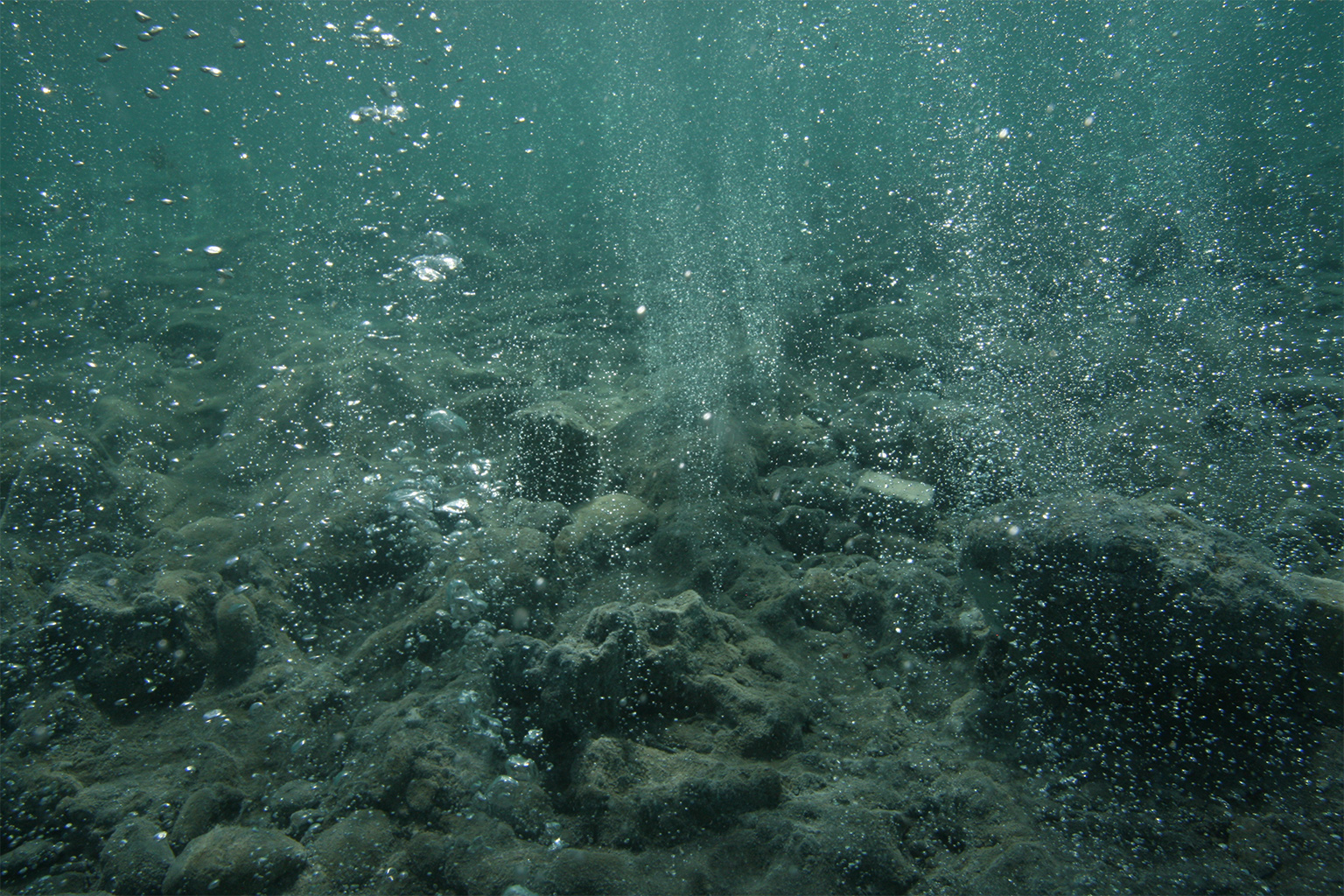
- A raised cobblestone road connects a small island, perched on the famous Aragonese Castle, to the island of Ischia, off the coast of Naples. Along the northern and southern edges of the island, carbon dioxide bubbles underwater from volcanic rocks. Around these effervescent strips of seabed, the water's pH ranges from a low of 6.6 to a normal 8.1. Between 7.8 and 7.7, values that will be common to all marine waters on the planet by the end of the century, according to the worst climate forecasts, seagrasses and macroalgae dominate the landscape.
- Since 2008, this area has been used as a natural biogeochemistry laboratory and a window to the future by scientists from around the world. Researchers working in these waters, naturally acidic due to the presence of underwater volcanoes, are studying, among other aspects of the local ecology, the animals and seagrass populations that have populated these rocks for generations.
- "There are photosynthetic organisms like Posidonia oceanica and other types of macroalgae that have already adapted to seawater acidification in some way," said Marco Munari, a researcher in Marine Ecology and Ecotoxicology at the Stazione Zoologica Anton Dohrn (SZN) in Naples, in an interview with Mongabay. Until earlier this year, Munari was the coordinator of the SZN's Ischia Marine Centre, before moving to a branch of the SZN in Fano.
Local populations of these organisms are already prepared for the stressors that populations in other areas may experience in the not-too-distant future.

- With pH levels at the levels projected by 2100 under the most pessimistic emissions scenario, seagrasses and algae will thrive. At the predicted CO2 concentration levels, these plants can maximize their photosynthesis capabilities, says Marco Milazzo, professor of Ecology at the University of Palermo who is studying underwater volcanic vents in Sicily and off the coast of Japan.
- The problem is that these seagrasses and macroalgae are almost the only marine organisms that are doing better, he added.
- Since the Industrial Revolution, the oceans have absorbed approximately 30% of carbon dioxide emissions from human activities such as fossil fuel burning, cement production, and land-use changes. This absorption has affected marine chemistry, decreasing the average pH of water from 8.2 to 8.1 . Such a change may seem insignificant, but the pH scale is logarithmic, and even changes of 0.1 are significant and can trigger a series of cascading changes in the composition of marine waters. In future scenarios, with rising CO2 emissions, the decrease in the pH of marine waters is expected to have catastrophic consequences for shell-building organisms such as mussels, clams, sea urchins, and corals, including countless microorganisms that support the marine food web.
- In this context, coastal habitats, consisting of seagrass beds, salt marshes, and tropical mangroves, have assumed even greater importance. Since 2009, the key role these systems play in absorbing carbon dioxide and other greenhouse gases from the seas has been recognized. Like trees and forests on land, these so-called "blue" ecosystems absorb carbon dioxide from the environment through photosynthesis, releasing oxygen and storing organic carbon in sediments. These habitats cover less than 0.5% of the seas but store half of the carbon, which is buried.

- Unfortunately, much of the surface area of these ecosystems has been lost due to coastal development, water quality, and other anthropogenic pressures. In the Mediterranean region, according to a 2015 article also cited in a more recent review, the iconic seagrass Posidonia oceanica has shrunk by 34% of its historical range over the past 50 years.
- "Human activities, such as trawling or the abandonment of fishing nets, which, with the movement of the waves, uproot these marine plants, correspond to the industries that are deforesting the Amazon to produce valuable wood," Munari argues. By 2030, both the UN and the European Community aim to expand the conservation and restoration of these ecosystems, which are capable of storing carbon dioxide.
- In Ischia, researchers have conducted experiments to test whether Posidonia oceanica populations that have adapted to naturally acidic waters can be used for environmental restoration in other areas. Experiments already conducted near underwater volcanic vents have shown that underwater vegetation, through photosynthesis, helps mitigate acidification and mitigates its effects on other species. Recent studies suggest that the absorption of dissolved CO2 and the release of oxygen through photosynthesis appear to make habitats more resilient to heatwaves and, presumably, other stressors such as pollution . Researchers at the SZN are currently conducting laboratory experiments to test the response of seagrasses and macroalgae to both heatwaves and water acidification.
- Additionally, they are planning field experiments with Cystoseira, a Mediterranean macroalgae not found around Ischia's volcanic vents. They will place different populations of Cystoseira along the slopes of the vents to test their responses to varying levels of acidity, thus identifying populations for use in other environmental restoration projects.
- “By testing the response of different populations to conditions of warming, acidification, and pollution, it is possible, for example, to identify those populations that are more resilient and, therefore, more suitable for environmental restoration purposes,” Munari wrote in an email.

- In the United States, scientists have proposed taking seeds of the common seagrass Zostera marina from Virginia and planting them much further north, in the waters of New York. The inspiration came from observing the northward migration of some species following warming waters. The idea is to help Zostera marina , which should be well-accustomed to the higher temperatures of Virginia, establish itself much further north.
- Simonetta Fraschetti, professor of Ecology at the Federico II University of Naples, and Erika Fabbrizzi, a researcher who recently completed a doctoral project on macroalgal forest restoration, believe it's important to identify populations that are better adapted than others, especially to temperature anomalies. Fraschetti's mantra, however, is: restore, restore, but first and foremost, mitigate, mitigate, and conserve. Returning a degraded habitat to its original condition is extremely costly: therefore, it's better to prevent degradation in the first place.
- During her PhD, Erika Frabbrizzi worked to identify priority criteria for those sites most likely to recover. Mapping marine habitats and their environmental conditions is a crucial first step, she stated. Furthermore, understanding the causes of habitat loss is key to the success of its restoration.
- For example, on Long Island, New York, where Alyson Lowell is conducting much of her research on seagrass metabolism and its effects on marine biochemistry as a doctoral student at Stony Brook University, light is the factor preventing eelgrass from providing better ecological services. Nutrient pollution in a densely populated area like New York City stimulates algal blooms, which deprive the seagrass of light for photosynthesis. "On Long Island, for effective environmental restoration, we need to clean up our water column," Lowell argues.

- According to Fraschetti, the factors that contribute to habitat degradation need to be addressed more urgently than water acidification. "In the Mediterranean, Posidonia oceanica is disappearing for reasons other than acidification," he said. "We must first focus on the causes of this disappearance."
- The IPCC Sixth Assessment Report claims that Posidonia oceanica could become functionally extinct by 2100, mainly due to warming marine waters.
- "Natural systems…are characterized by extremely strong resilience," Fraschetti states optimistically. "Let's start from this to avoid global desertification by the end of the century."
🌟 Join the Glowmentra Family! 🌟
You made it to the end — that means you loved what you read! 💖
Why stop here? ✨
📩 Subscribe to Glowmentra
💬 Your brighter, happier life starts here.
📢 Share the glow — happiness shines brighter together! 💛
✨ Glowmentra — Let Your Days Shine Brighter!
nice
ReplyDeletewow
ReplyDelete