Researchers at Flinders University and German biotechnology company one • five have created an algae-based coating designed to replace the plastic used in fast food packaging.
Many food containers and wrappers contain harmful plastics derived from fossil fuels that do not biodegrade. They break down into microplastics that pollute the environment and damage marine ecosystems.
In the Philippines, researcher Denxybel Montinola has developed another type of natural film from mangoes and seaweed that he hopes to bring to market this year.
The development of algae-based bioplastics and coatings could boost the livelihoods of algae farmers, who would benefit from an industrial sector that would help them feed their families and send their children to school.
Algae, a generic term used to describe several types of marine plants found in various bodies of water, not only provides food and shelter for marine animals but can also help solve the problem of plastic pollution. Researchers at Flinders University in Australia and the German biomaterials company one • fıve have developed a new, non-polluting algae-based coating material "designed to replace traditional fossil-based plastic coatings used in grease-resistant fast food packaging."
The initiative aims to transform packaging and plastics production globally, significantly reducing reliance on polluting conventional plastic, according to a Flinders University press release .
The material used to wrap fast food burgers and fries is typically laminated with a thin layer of plastic to make it grease-resistant, but this poses a recycling problem, as this layer is typically made of synthetic, petroleum-derived polymers , such as polyethylene or polypropylene. This material is non-biodegradable and breaks down into smaller pieces called microplastics.
Flinders University researchers (left to right) Peng Su, Chanaka Mudugamuwa, and Zhongfan Jia test the biopolymer coating for potential use in fast food and other food packaging. Image courtesy of Flinders University.
For biodegradable and compostable plastics to have a positive environmental impact, they must meet a series of conditions. First, the biomass used to produce plastics must be sustainably sourced. Second, biodegradable plastics must be used with caution and not used as an excuse to make a mess. Finally, industrially compostable plastics will only be permitted for certain products and should be used only when they have environmental benefits, do not negatively impact the quality of the compost, and in the presence of an adequate organic waste collection and treatment system.
According to Zhongfan Jia, principal investigator at the Flinders Institute for Nanoscale Science and Technology, the algae-based coating material they developed uses natural polymers rather than fossil fuel-based products. Unlike synthetic polymers, natural polymers are found in nature and are extracted from plants or animals. The new coating material is derived from sodium alginate , which is obtained from brown algae and is typically used as a thickening, gelling, emulsifying, and stabilizing agent, which also improves product texture.
As Jia explained, seaweed extracts have a similar structure to the natural fibers from which paper is made: simple chemical modifications have been made to improve the grease and oil-resistant properties in order to preserve food for a period of time.
"Essentially, we make simple modifications while maintaining the biodegradable or biocompatible properties of the algae polymer, only to gain additional properties," Jia said. "So theoretically, we shouldn't have any problems recycling this polymer to make paper, since it has a very similar structure to artisanal paper."
Although the coating formulation material is made from natural polymers extracted from seaweed native to the coast of South Australia, Jia says it is also possible that other countries will adopt this technology.
“If we can extract it here, we won't need to import the algae from elsewhere, but that doesn't mean it can't be used elsewhere,” Jia said. “Growing the algae and extracting the polymer only makes sense if others find their uses.”
In different countries, seaweed is used in different ways. In Japan, Korea, and China, seaweed is used as human food: fresh, dried, or as an ingredient in prepared foods. In Indonesia , it is used in the manufacture of edible cups and food wrappers, among other things, to address the problem of plastic waste. It can also be used for industrial purposes by extracting alginate, agar, and carrageenan, which are thickening and gelling agents.
Philippine seaweed is exported to the United States, China, Spain, Russia, and Belgium, where it is prized for its carrageenan, a gelatin-like additive used as a thickener and stabilizer in many food and cosmetic products. Image by Keith Anthony Fabro for Mongabay.
Algae and bioplastics in the Philippines
In the Philippines, one of the world's leading producers of aquatic plants, researchers are developing new solutions to the plastic packaging problem, among many other uses for seaweed. Since the 1970s, commercial seaweed cultivation has become one of the Philippines' most important coastal enterprises, supporting more than 200,000 families. It is particularly valued for its carrageenan, a gelatin-like additive used as a thickener and stabilizer in many food and cosmetic products, such as whipped cream, chocolate milk, and ice cream.
In 2019, a Filipino named Denxybel Montinola made headlines by developing a bioplastic film using mango and algae, both abundant raw materials in the country. He submitted his invention to the 2019 DOST-BPI Science Awards competition and was one of 30 outstanding university students who received an award for their scientific research and innovation.
"Algae grows very quickly, so we can use it safely and sustainably. Nowadays, we're very concerned about sustainability, so we want to use a raw material that won't harm the environment, and that's algae," Montinola told Mongabay.
Testing of bioplastic film made from algae and mango peels. Image courtesy of Denxybel Montinola.
Algae are “primary producers,” meaning they obtain energy from sunlight and necessary materials from non-living sources, and they grow rapidly, about 30–60 times faster than land plants.
Mango, the Philippines' national fruit, is the country's third-largest crop : in 2015, the country ranked seventh in fresh and dried mango exports.
As Montinola explained, the bioplastic he developed is made by processing the raw materials to extract its polymers: carrageenan from algae and pectin from mango peels. These polymers were combined without using a plasticizer, which is an artificial component that makes the material elastic like petroleum-based ones, making it biodegradable.
"In the case of my invention, if you immerse the bioplastic in water, it completely dissolves into its raw material, which is just the polymers from algae and mango peels. So it doesn't turn into microplastics, like traditional petroleum-based plastics," Montinola said.
According to Montinola, this invention utilizes a resource that would otherwise be wasted, as mango peels are a byproduct of mango production. Using them rather than letting them rot could provide farmers with an additional source of income if mango-algae bioplastic production is scaled up.
Montinola also agrees that it would be possible for other countries to adopt his technology, depending on their ability to produce or procure the necessary raw materials.
"If the country doesn't produce mangoes or seaweed, we could try using other raw materials... Seaweed is a hardy product that can grow well in tropical or cold climates. So I think it's a really good idea to start with seaweed as the basis of the biofilm," Montinola said.
Prototype products: (From left to right) Biofilm-based candy wrappers, a semi-refined opaque biofilm sheet, and a refined transparent biofilm sheet. Image courtesy of Denxybel Montinola.
The marketing of algae-based bioplastics
The biocoating materials for fast food wrappers developed by Flinders University and one • five are intended for commercial use. However, according to Jia, industrially significant volume production of the natural polymer coating is still a work in progress.
"We're trying to create a product that can be adapted to the industry's current production line. This would make commercialization quicker and cheaper because there would be no need to build new factories," Jia said.
The research phase is complete and the invention is working at the laboratory level, Jia said. The next phase will involve testing the safety of this coating to ensure it meets the regulations for food contact materials (FCMs) , meaning materials that come into contact with food before consumption, including packaging and containers. They must comply with regulations to ensure a high level of food safety.
“Additional safety measures need to be taken to meet local requirements for different countries with different regulations, so the product will take time before it finally hits the market,” Jia said.
Similarly, in the case of Montinola's bioplastic film, the goal is to make it market-ready. However, there are obstacles to overcome, such as the lack of funding and technical challenges in producing bioplastic compared to traditional petroleum-based plastics.
“Traditional plastics use extruders to create single-use plastic bags, but we don’t yet know if we can use the same material or manufacturing process for bioplastics,” Montinola said.
As of this writing, Montinola plans to launch the project this year with the goal of commercializing the product. In addition to providing sustainable alternatives to conventional plastic, the production of these coatings and biofilms could also help create livelihoods.
"I think we'll create new opportunities for algae farmers," Montinola said. "Plus, I think we could create a new bioplastic production industry."
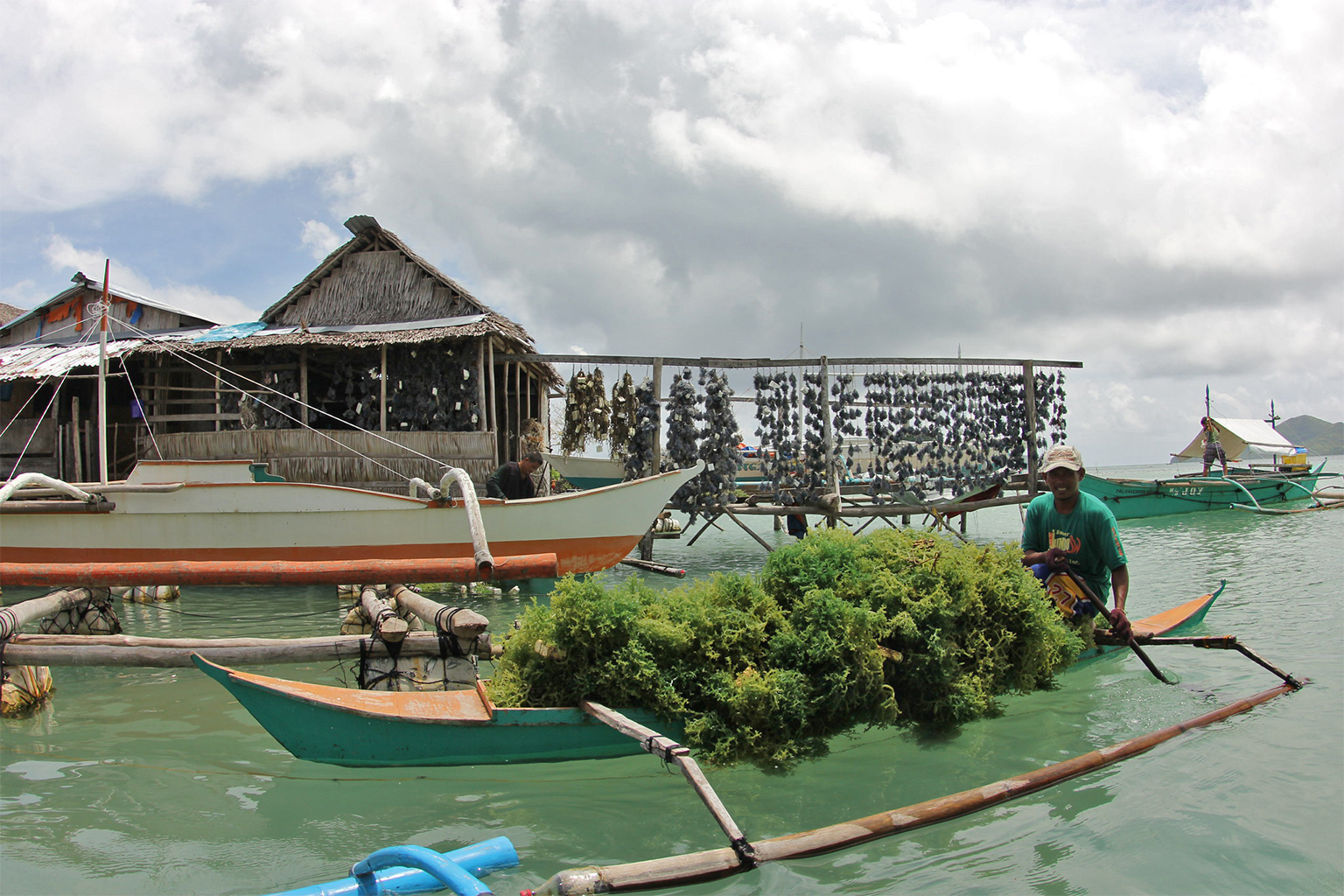
A fisherman from Taytay in Palawan, Philippines, collects seaweed as an alternative source of income. Photo by USAID CTSP/Jun Lao via Flickr ( CC BY-NC 2.0 ).
Using algae for commercially available bioplastic coatings and films could push the industry to extract more polymers, which would lead to increased demand for algae.
"If the industry needs more polymers from algae, it will push farmers to grow them. So it has a knock-on effect," Jia says.
Seaweed farming on the Philippine island of Palawan has not only helped raise the socioeconomic status of families, but has also built a sense of community. It has strengthened the status of women who farm seaweed, enabling them to contribute to their families' livelihoods and pay for their children's schooling. Seaweed farmers also play an important role in protecting marine life, which is why Montinola has called on the government to make funding more accessible to innovators.
"For young people, we're in the age of social media. There are really important problems to solve, and I think we should sometimes focus on them and amplify the voices of young innovators and young activists to truly change the world," Montinola said.


Post a Comment