- According to scientists, deep-sea mining activities could affect cetaceans due to noise pollution, which could interfere with their communication processes.
- A team of experts believes that impact assessments of these activities have focused on species found on the seabed rather than on the large animals that pass through areas where mining is planned, and that urgent research is needed to understand the potential impact on cetaceans.
- However, one mining company says the potential impact on cetaceans from its planned activities is being assessed by examining acoustic data collected during its recent mining test in the Clarion-Clipperton Fracture Zone, which will be analysed alongside baseline environmental data over a three-year period.
- International deep-sea mining could begin this year after the Pacific island nation of Nauru, which supports the operations of a Canadian mining company's subsidiary, requested expedited mining licensing.
The potentially imminent start of international deep-sea mining could impact whales, dolphins, and porpoises, particularly through noise pollution, experts say, calling for urgent research.
In a new paper published on the Frontiers in Marine Science website , scientists from the University of Exeter, Greenpeace Research Laboratories, and Oregon State University argue that proposed deep-sea mining would likely produce a range of noises at frequencies similar to those used by cetaceans to communicate, potentially leading to behavioral changes in these animals.
The authors state that most assessments of the potential impact of deep-sea mining on biodiversity have focused on "bottom-bound species rather than large, transiting animals" such as whales and dolphins. This is partly due to the paucity of data on cetaceans in areas targeted for mining, says lead author Kirsten Thompson, a marine scientist at the University of Exeter in the UK.
“Cetaceans are a very diverse group of animals, and most of what we know about them comes from studies conducted primarily near the coast and on offshore islands,” Thompson wrote to Mongabay in an email. “Off-shore research is difficult, and the fact that it has largely been overlooked in mining impact assessments speaks volumes about how little we know about the species that live there.”

Deep-sea mining operations could begin in the immediate future
- International deep-sea mining has not yet begun, but members of the International Seabed Authority (ISA), a UN-linked regulatory body, are working to develop regulations that would allow it to begin in the near future (perhaps as early as this year). One proposed form of deep-sea mining would involve polymetallic nodules, metal-rich rocks containing nickel, cobalt, copper, titanium, and rare earth elements found in deep-sea plains. As countries strive to reduce greenhouse gas emissions, demand for these materials is growing for renewable energy technologies such as wind turbines, solar panels, and electric car batteries . According to a 2021 report by the International Energy Agency, these minerals are currently mined onshore, but there is a shortage of them to meet the energy transition.
- Those in favor of deep-sea mining believe that such activities will provide a substantial supply of metals, which is essential for the transition to climate-friendly energy sources. They add that deep-sea mining will be much less destructive than onshore mining.
- Opponents, however, argue that too little is known about deep-sea habitats and the species that live there to adequately assess the potential impact of deep-sea mining on the oceans. They also argue that, based on current knowledge, such mining appears likely to cause irreparable damage to the ancient marine ecosystems that help sustain all life on the planet.
- In June 2021, the Pacific island nation of Nauru, which supports the operations of a subsidiary of Canadian company The Metals Company (TMC), invoked a "two-year rule" in the United Nations Convention on the Law of the Sea (UNCLOS) to urge the ISA to allow deep-sea mining operations to begin within two years, regardless of the rules in effect at the end of that period. Experts believe this authorization could kick-start TMC's operations and pave the way for other companies and states to support mining operations in the world's oceans.
- Following Nauru's request, the ISA has scheduled a series of meetings to finalize mining regulations within two years so that such activities can begin. While some ISA member states are in favor of proceeding in this way, others, including France, Chile, New Zealand, and Palau, have called for a moratorium, a "preventive pause," or even a complete ban on deep-sea mining. Many conservation scientists and companies such as Renault, Rivian, BMW, and Samsung SDI also oppose deep-sea mining.
“Sensitive to noise”
- According to the new paper, cetaceans "produce and detect sounds in specific frequency ranges" for communication purposes related to feeding, social interaction, and reproduction. The authors argue, however, that deep-sea mining could compromise these behaviors by transmitting various anthropogenic sounds at various frequencies (from equipment used for mining, operating, and monitoring mining operations) through a process known as "acoustic masking." Low-frequency sounds, such as the noise produced by surface ships, could travel hundreds of kilometers into the ocean, potentially affecting cetaceans across a wide area. The authors believe it is "reasonable to expect" that commercial mining activity occurs 24 hours a day.
- The report draws particular attention to the Clarion-Clipperton Fracture Zone, a 4.5 million square kilometer area in the Pacific Ocean designated for deep-sea mining, which provides habitat for 30 cetacean species, including the critically endangered sperm whale ( Physeter macrocephalus ), fin whale ( Balaenoptera physalus ), and blue whale ( Balaenoptera musculus ). Beaked whales, known to be extremely sensitive to anthropogenic sounds, such as military sonar, also live in the area.
- “These elusive [beaked] whales are the true deep-sea divers of the whale family and likely feed at depths where mining activities might occur,” Thompson says.
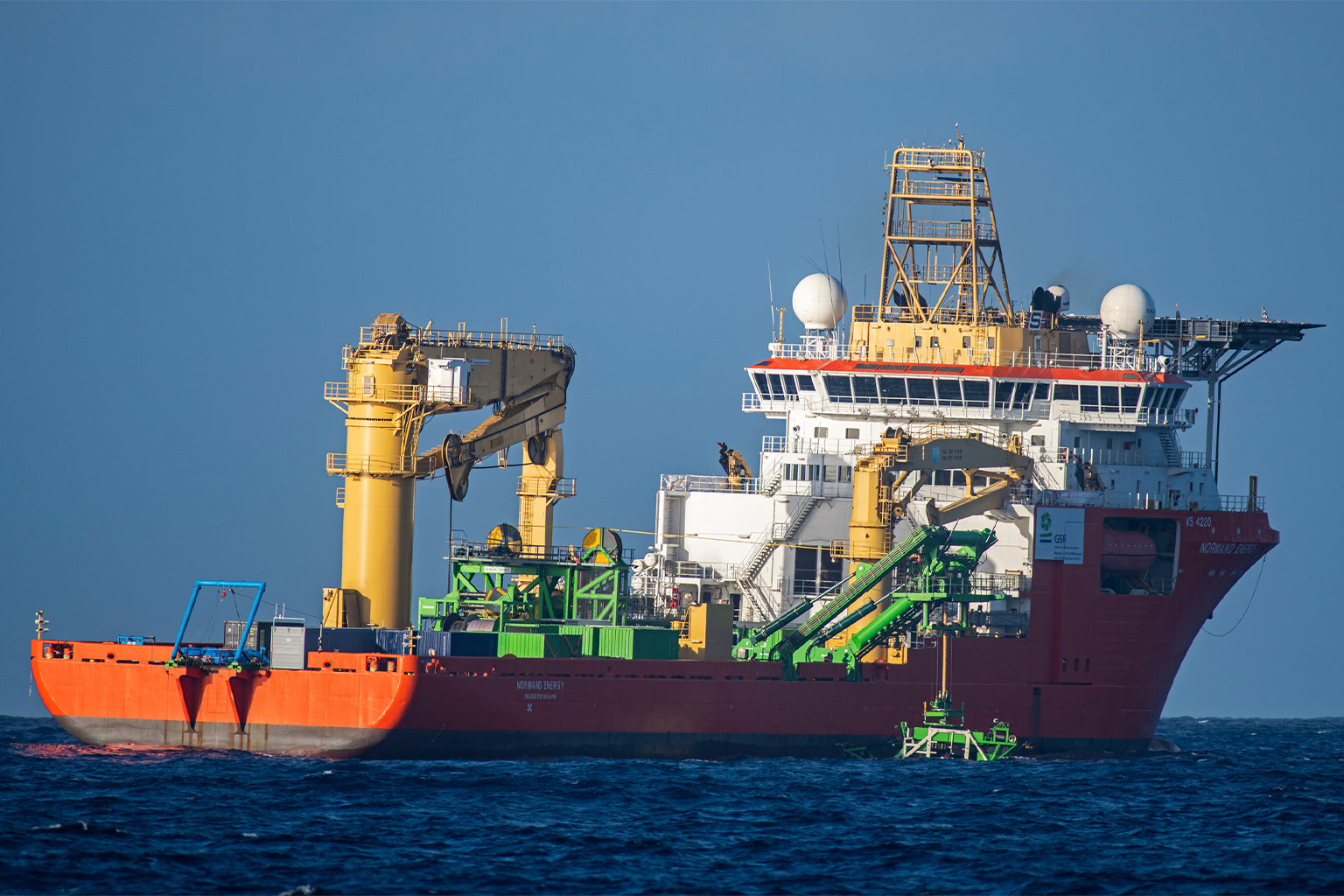
- In September 2022, TMC and its partner, AllSeas, conducted a mining test in the Clarion-Clipperton Fracture Zone , harvesting approximately 14 tons of nodules. The test was controversial after scientists monitoring the test leaked a video showing sediment being dumped onto the ocean surface, raising questions about the environmental impact of mining. A 2020 report suggested that the dumping could be environmentally destructive due to the dispersal of sediment and dissolved metals . In a response posted on its website, TMC called the incident a "limited incident" that "could not cause harm to the marine habitat."
- TMC CEO Gerard Barron also told Mongabay that the company is assessing the noise and potential effects on cetaceans by developing a "validated underwater acoustic model," created in collaboration with experts from HR Wallingford, an environmental engineering and hydraulics group, and the Scottish Association of Marine Science. In an email to Mongabay, he added that the company collected acoustic data during its recent test mining operations in the Clarion-Clipperton Fracture Zone, which it will analyze along with three-year baseline environmental data to prepare the environmental impact statement (EIS) that TMC is required to submit to the ISA in order to apply for a commercial mining license.
- According to Barron, "the data collected during the pilot trials of the collection system will allow us to understand the potential impacts on marine mammals and, if necessary, how we can optimize our system to mitigate those impacts. He added that the company is working to ensure its operations "remain within environmentally sound thresholds."
- The company notes that TMC's environmental impact statement would be made public if the company ultimately applies to begin mining operations.
- Thompson, of the University of Exeter, believes it is important to ensure there are peer-reviewed scientific assessments of the noise generated by mining activities and their impact on cetaceans, but that such assessments have not yet been published.
- "We know that ocean noise pollution is already a problem for cetaceans, and the start of a new type of operation that would be expected to continue 24/7 would inevitably create more anthropogenic noise if deep-sea mining were to continue," Thompson says. "Despite the lack of information, it appears that industrial-scale mining may soon begin in one of the planet's few remaining untouched habitats."

- According to the report, noise isn't the only issue that could negatively impact cetaceans. They could also be affected by sediment plumes generated by seabed mining operations, as well as sediment dumping, which could "cloud the water column and cause the movement of contaminants." The authors also express concern about future deep-sea mining activities potentially affecting seamounts, which are rich in metals needed for renewable energy technologies.
- "Seamounts are now known to be important deep-sea habitats for some cetacean populations that feed or congregate around them, but we still lack fundamental knowledge about these fragile ecosystems," says Solène Derville, co-author of the report and a marine mammal scientist at Oregon State University. "In light of this, it is very complex to assess the extent of the impacts that seamount mining activities may have on the animals that live and feed around these structures."
- The authors add that further research is needed to understand how plumes generated by mining activities and seamount degradation may affect cetaceans.

Evaluations “urgently needed”
- Naomi Rose, a marine mammal scientist at the Animal Welfare Institute who was not involved in the study, believes it is “absolutely absurd” to continue deep-sea mining.
- In an email to Mongabay, Rose states that "the impact on cetaceans could also be considerable, as species that periodically dive to such great depths (e.g., beaked whales) have already been shown to be particularly sensitive to acoustic disturbances while underwater." "However, the impact on cetaceans is the least of concern in deep-sea environments. The entire species landscape that constitutes benthic [seafloor] ecosystems will be damaged and destroyed by deep-sea mining."
- Rose believes that, at the very least, "meaningful environmental assessments should be conducted" before authorizing mining activities. "This certainly applies to any human activity in untouched habitats, but in this case, they are urgently needed," he adds.
- Thompson says such assessments, which would require in-depth analyses of cetaceans in areas targeted by mining activities, would be “logistically difficult and therefore expensive” but feasible.
- "We can use acoustics, molecular methods, visual analysis, and potentially remote sensing to identify species present in deep-sea areas targeted for mining," he says. "Such analyses will take time, but we need this detailed information before proceeding with any commercial mining activities."
- Thompson believes that deep-sea mining should not proceed without adequate knowledge of how such activities may affect cetaceans.
- “Once mining starts,” he argues, “it will be difficult to stop.”
Post a Comment