- Being compared by more than one reviewer to Henry Thoreau and Rachel Carson would make any nature writer happy. But add glowing reviews comparing him to a jazz musician, Ernest Hemingway, and Charles Darwin, and you get an idea of the praise heaped on Carl Safina for his new book,
- Like Safina's other books, The View from Lazy Point focuses on the beauty, poetry, and crisis of the world's oceans and their hundreds of thousands of unique inhabitants. After taking the reader on journeys around the world (the Arctic, Antarctic, and the Tropics), Safina always returns home to absorb the views and write about the natural life of her home, Lazy Point, Long Island.
- While the primary focus of her new book is on the myriad ways the ocean has been degraded, depleted, and ultimately compromised as an ecosystem (such as overfishing and climate change), Safina always finds room for hopeful stories, such as how some animals, and in turn, nature itself, manage to survive in a world increasingly dominated by humans. But what sets Safina's book apart from other nature literature is her ability to seamlessly transition from practical contemporary problems to the ancient philosophical principles that have brought us this far. In this way, Safina manages to look forward.
- In an interview with mongabay.com, Safina discussed the many dangers facing marine life; the recent Gulf of Mexico oil spill (which she will address in her upcoming book); her views on capitalism, consumerism, and religion; and how we could save the world by extending our compassion to all life.
- An interview with Carl Safina
- OCEANS
- Mongabay: Of all the ocean crises—overfishing, pollution, acidification—which do you think is the most urgent to solve?
- Carl Safina: It depends on what you mean by urgent. The purpose of fishing is to kill and eliminate enormous quantities of marine life, and they're doing it very well. In fact, there's a lot of overfishing (catching fish before they can reproduce), which has caused a substantial decline in fish populations almost everywhere in the world. Fishing has been the main cause of change in the oceans, and we all contribute to it every time we eat fish. Information on sustainable fish consumption is available at blueocean.org or through our iPhone app, Fishphone. Pollution is very serious in some places and is characterized by numerous factors: toxic chemicals, fertilizers, gender-bending hormones (from birth control pills to estrogen-like chemicals), plastics, and mercury from burning coal. Arguably, much more serious than these types of pollution is the carbon dioxide produced by burning fossil fuels. The consequences are a shift in the entire planet's thermal balance and ocean acidification. This is why polar ice caps are melting, sea levels are rising (due to the melting of glaciers and continental ice sheets), and increasingly acidic marine waters are already eliminating young shellfish in some regions (for example, the West Coast of the United States, where acidification is killing oyster larvae in nurseries) and slowing and reducing coral growth. Overfishing could be stopped tomorrow, but only now have we begun to reduce the use of fossil fuels. I believe that the problems caused by carbon dioxide represent the most pressing threat, as they are the cause of the most severe, long-term, and difficult-to-stop ocean changes. The fact is, all these problems should be solved.
- Mongabay: What is your opinion on the Gulf of Mexico oil spill and the government's response?
- Carl Safina: I've written an entire book on the subject, which will be released in April. It's called A Sea in Flames . The explosion was caused by a lot of human error and poor judgment; the tragedy could have been easily avoided. The government and oil companies were completely unprepared. Most responses, such as skimming and disposal operations, barely scratched the surface and didn't help much. The effects on tourism and fishing were primarily psychological: many fears, fortunately, turned out to be worse than the effects of the oil in this case. Given the depth, the distance from shore, the nature of the crude oil, and the temperature of the Gulf, the large amount of oil appears to have caused less damage in the Gulf than the Exxon Valdez in Alaska did with much less oil; in fact, the damage is not directly proportional to the amount of oil. Certainly, birds and turtles died in the Gulf disaster, but it could have been much worse under other circumstances. If it had happened in cold waters like Alaska, it would have been a nightmare. But the thing that is really destroying the wetlands along
- the Gulf and threatening the future productivity of their fisheries is something that existed before the explosion and continues to exist today: the 8,000 miles of canals that are shredding the delta's wetlands and the flood control that dumps the mud and sediment that form the Mississippi wetlands directly into the Gulf instead of the delta. The marshes and swamps that are nurseries for fish and crabs and habitats for other flora and fauna are disappearing at the astonishing rate of 25 square miles per year. Flood control and canals for shipping have done and are doing far more to destroy the Gulf's wetlands than the 2010 explosion ever will.
- Mongabay: Most of the news about the ocean is grim. Have there been any positive developments?
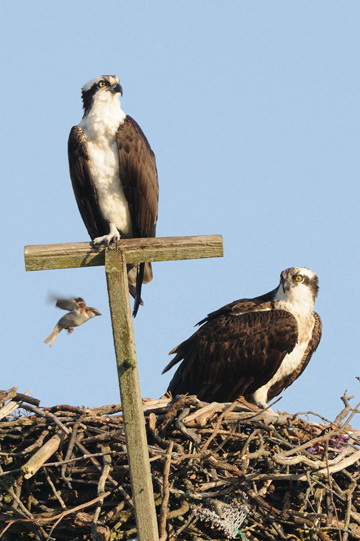
Ospreys around Lazy Point. Photo courtesy of Carl Safina.- Carl Safina: Where people have eliminated the problems that were destroying nature—from banning DDT to halting overfishing in some areas of the US coast—plant and animal life have shown a tendency to recover. This has been true for the once-rare ospreys that we can now regularly see around Lazy Point, as well as for certain fish, such as smallmouth bass, whose numbers have begun to increase following fishing restrictions. Another positive fact is that many people are now interested in these issues. In some countries, human population growth is slowing or even reversing; this is because people have received better education and desire smaller families. So it's natural to imagine successes and point to positive examples around the world. It turns out that if you're interested in nature conservation, one of the most important things to do is teach girls in developed countries to read and write. This is part of what I mean when I say that nature and human dignity need each other.
- NATURE
- Mongabay: What is the Circle of Compassion?
- Carl Safina: It's the perimeter that defines where we choose to apply the golden rule of "treat others as you would like to be treated." For most people, this rule includes their family and loved ones, their children. But it could be extended to everyone we know, to strangers in our city or country, to all other people like us, to all people regardless of their differences, to future generations, to all living creatures, or to the entire world. The history of human progress has been a widening of the circle of compassion. Every time we've widened our circle of compassion—think of any movement for human rights, civil rights, women's rights, gay rights, or the preservation of nature—it's always been difficult, but history has always shown that it's absolutely the best thing we can do to improve life and improve ourselves. It's the only way we can move from being merely human to being civilized to the next step, which is becoming fully humanized. In our journey through life, compassion is the compass that points us in the right direction.
- Mongabay: Why should we feel compassion for other species?
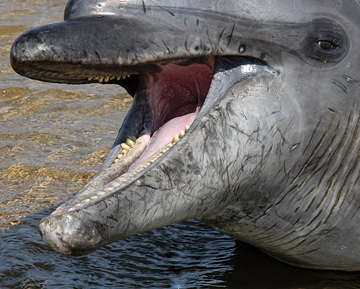
An aging dolphin. Photo courtesy of Carl Safina.- Carl Safina: Simply because it's not right to spread pain and suffering, because that makes life worse. Compassion is the most special and wonderful characteristic that distinguishes our species. Sometimes we are capable of doing monstrous things to ourselves and to what sustains us in life. This too is part of human nature. Compassion allows us to stay on the positive side. Every tradition with a bit of common sense recognizes that compassion is the best thing we have and represents the path to peace. You can't be compassionate only towards people and cruel towards other living creatures and indifferent to the fact that you are the cause of their suffering. That doesn't work, because the lack of compassion towards other living beings becomes a bad habit that also erodes compassion for human beings.
- Mongabay: At what point should this compassion stop?
- Carl Safina: It should never end. Our job is to increase it. I'm not trying to promote a complete renunciation of the killing and use of animals, although I think that's the best path to take. But if I kill some fish for food, it's because that's how I've decided to participate in the natural world around me. I'm not the one who should tell people what to do; I'm just trying to make them think and see the bigger picture when they decide what they want to be. I'm trying to promote containment, improvement, and a focus on acting more humanely. I'm trying to engage people by making them understand how much I love the world, but it's not my job or desire to dictate to others how to find the right balance or the right pursuit in their lives. It's much more important that they find a balance and a concrete pursuit around which to center and expand their existence.
- Mongabay: Why do you think nature conservation is a better philosophy than animal rights?
- Carl Safina: One doesn't exclude the other, but the philosophy of animal rights is too narrow. People who are concerned only with animal rights think about the suffering of individual animals, but if a herd or an entire species disappears without anyone trying to harm them directly, then animal rights activists are inclined to remain silent and ignore the causes of the wholesale destruction of forests and entire species. Animal rights activists aren't interested in the connections between nature and humanity. Forests and seas aren't animals, and so animal rights activists aren't present when it comes to combating forest destruction and marine pollution. Put more simply, concern for animal suffering alone isn't enough to address and solve the major problems that threaten the world and the future of people and life on Earth. Of course, I'm not criticizing the desire to treat animals more humanely, which is what we should do. But that alone doesn't allow us to get where we need to go.
- Mongabay: Is the unnatural world, then, a wrong world?
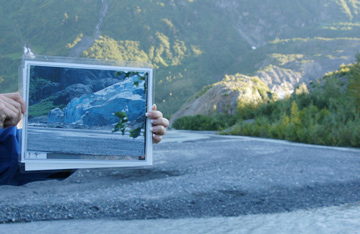
A few years ago, the glacier was here. Photo taken in Alaska by Carl Safina.- Carl Safina: When I say natural, I mean things that happen independently of people. But humans are now the primary agents of change on Earth's surface. We are responsible for the distribution and wealth of nearly every living community in the world, even in places far from most people, like the polar regions and the open oceans. Our actions impact things at a speed and scale previously attributed to natural forces like asteroid strikes and major volcanic activity; in the past, these phenomena caused instantaneous extinctions and atmospheric changes. Now, we are causing exactly the same global changes with the same speed and longevity. There are many unnatural things I love, such as art, books, science, medicine, generosity toward the less fortunate, and our ability to farm. But we have truly crossed the line of what is sustainable. We have gone so far in trying to protect ourselves against nature that we are destroying our long-term solutions and the prospects for peace and human dignity. It is patently wrong to hand over to future generations a damaged and impoverished world compared to the one we inherited. By creating resource scarcity for the future by doing things like cutting down forests, emptying oceans, and decimating aquifers, we are condemning future generations to face greater competition and friction. We have no moral basis for such a destructive attitude.
- Mongabay: Is it human nature to desire infinite consumption?
- Carl Safina: I don't think so. Throughout much of history and the present, most people have lived very modestly. Research shows that the happiest people are those who consume at the most modest levels, and that, if basic needs are met and one is reasonably free from political oppression, having more stuff doesn't make one happier. Many religions preach that it's wrong to focus on material things and that it's right to seek fulfillment from one's work, serve one's community, have compassion for the less fortunate, and pursue more spiritual pursuits. In this country, it's only been in the last half century or so that growth has become a goal, and commercialization has so pervaded our daily environment that we're constantly bombarded with messages telling us not to be satisfied with what we have, to want to look different than we are, and to have more than we have. It's a disease, and you can clearly see it's making people sick. I believe that if the infinite expansion of consumption were a natural thing, obesity and diabetes would not be recent problems and marketers would not waste so much energy and so much money on advertising to convince us to be dissatisfied with who we are and unhappy with the immensity of things that already belong to us.
- Mongabay: Could we ever be satisfied with less stuff and more nature?
- Carl Safina: It's the only way the human mind and heart can be satisfied. That, and also trying to serve our community. And it's true that people with fewer things are more satisfied. Research shows that people are happier with a modest amount of things; people who own more material things are not the happiest.
- SOCIETY
- Mongabay: You argue that our institutions currently remain stuck in a medieval or ancient mindset. What's your vision for a new philosophy?
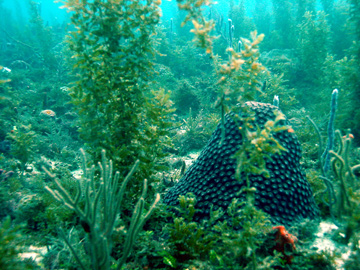
A diseased coral reef covered in algae in Belize. Photo courtesy of Carla Safina.- Carl Safina:If we think about what we've learned in the last 150 years alone, we can see the profound disconnect between how we humans do business and how the world actually works. Our economic system, religions, and the relationship between philosophy and the world were established before anyone knew the earth was round, or that it undergoes transformation, and certainly before anyone thought people had the power to change the world; these reflect how we understood the world when we knew nothing about it, and it shows. An improvement in the situation is possible with relatively few, truly basic changes, but I realize that's asking too much. For starters, the economy should include the true cost of products in its prices. For example, coal is so "cheap" because its price doesn't include the costs of destroying mountains, the health problems of miners, the mine acid flowing into rivers, global warming caused primarily by coal combustion, ocean acidification killing shellfish and degrading the coral reefs on which millions of people depend, and the release of mercury into fish. All of these things constitute the real cost of coal, but they aren't included in its price. Coal is cheap, but it's undoubtedly the fuel that costs us the most. Who pays these costs? All of us. If these costs were included in the price, coal would be very expensive, and, better yet, cleaner energy technologies would be more competitive. This would be a market that works because it is capable of recognizing and reflecting reality. We cannot survive in a society that privatizes profits and socializes costs, whereby a few get rich by passing enormous problems on to everyone else. Enron failed because it tried to hide its true costs. As for other institutions, religions should engage more actively with the enormous moral implications of the changes we bring to the world and of leaving those yet unborn a damaged and impoverished world compared to the one we inherited. We should have a philosophical tradition that focuses less on how people behave towards one another but rather gives greater space and voice to how people behave towards the future and how they interact with their fellow humans on this journey through time. Our actions should be based on the fact that it is only in the last 150 years that we have realized that the world is changing and that we are the ones making it change, that there is a relationship between all living beings, that what keeps us here is not only the human community but also the non-human community.That the life forms that were with us before our arrival should continue to be companions to our children, and that we should understand that nature and human dignity need each other. For an extreme example of how the destruction of nature leads to misery and a loss of hope, consider Haiti.
- Mongabay: Has capitalism failed?
- Carl Safina: In a way, yes, but not because capitalism is wrong. The economic system has caused enormous damage because we have abused the ideas of ownership and entrepreneurship. With moderation and compassion, these things could bring many benefits, but our system rewards unbridled greed, and this is proving highly destructive.
- Mongabay: What's your view on emerging financing for markets for ecosystem services? Do you think this could exacerbate problems or offer a way to address what economists call externalities?
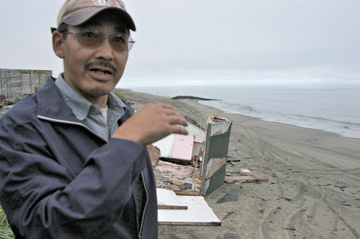
Eskimo village in Alaska destroyed by erosion. Photo courtesy of Carla Safina.- Carl Safina: What economists call externalities are entirely intrinsic factors. This shows that most economists have no idea how the world works, and that energy economists are wasting money creating an artificial way to spread expenses across shared time and space. This is simply irresponsible and reckless, and it's a large part of the reason the economic system is working against us. So yes, I think payments for pollution and social and environmental damage help force the market to price products more realistically by including, rather than ignoring, the true costs involved in various business decisions, government policies (such as subsidies), and trade.
- Mongabay: What kind of economic system would provide people with what they need while conserving natural resources for future generations?
- Carl Safina: Fundamentally, we cannot have an economic system devoted to continuous production on a planet that isn't growing. Constant production means pumping more and more material into the system; that can't work. It could work if we focused on growth rather than production, which means looking at quality rather than quantity. The population can't grow infinitely, and neither can the economy, because the planet is finite and cannot expand. It would be a major step toward what we need if we eliminated incentives and subsidies aimed at destroying the planet. We certainly need private funding from elections to promote grassroots campaigns for financial reform. Money, a corrupting presence in politics, has stolen our government and destroyed the idea of a government that belongs to the people, is made by the people, and is built for the people. Despite the recent Supreme Court decision, corporations aren't human beings. Humans have belly buttons. Corporate "free speech" completely swamps our national discourse and our elections because corporate money advances careerist agendas that drown out the real voices and true interests of the majority. Economic policies should abandon this suicidal obsession with production and focus on the stabilization and moderation that make us happiest and provide us with the best long-term opportunities to improve lives, secure peace, and survive. Then we would be fine.
- Mongabay: Do you think world religions play an important role in spreading an ethical approach to the environment, both locally and globally?
- Carl Safina: Certainly, because many religions (and we must give them credit for this, because it's a very important thing) don't value profit above people. However, to their discredit, their focus on the spiritual realm and the afterlife allows them to ignore, and even denigrate, their relationship with the earth. Religions could emphasize those passages in scripture that speak of our role as stewards of creation and concern for future generations, and they could combine this call for stewardship with science, which demonstrates how rapidly we are changing and exhausting this world in which, by some miracle, we find ourselves. I've noticed some religious movements embracing these ideas; I think this is very encouraging.
- Mongabay: What gives you hope?
- Carl Safina: I'm deeply inspired by the strength of the migratory birds, fish, and other creatures that pass through Lazy Point or that I encounter on my travels. They give me joy, comfort, and hope. These creatures fight with all their might to survive and continue the chain of life that brought us all here from the distant past. They never ask if they should be optimistic; they simply are. They are a source of learning. Despite the desolation and tendencies toward destruction, the world still shines with vitality. We have so much, but there's only so much left. We're all here, and that's the only hope I need to begin and continue.
- Mongabay: Given the scale and complexity of these problems, what can an individual do?
- Carl Safina: First, we can always strive to be better in our personal lives. That's something we can start working on. Then we can abandon the culture of consumerism; we'd lose nothing by ignoring advertising and holding on to our money, our dignity, and our peace. He who knows he has enough is a rich man. We also need to engage in the political process: write letters to elected officials, demanding an end to subsidies to the supermajors of oil, coal, and agriculture; demand clean energy; demand better schools and higher standards of teaching and education; honor knowledge and science; and connect truth with values. Then we can say the best thing anyone could ever say: "I did my best." We should always enjoy, savor, and fill ourselves with the mysteries and wonders of life.

Post a Comment