Rainforest Conservation: A Year of Analysis
- 2009 could prove to be a turning point for tropical forests.
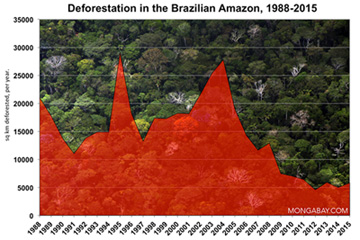
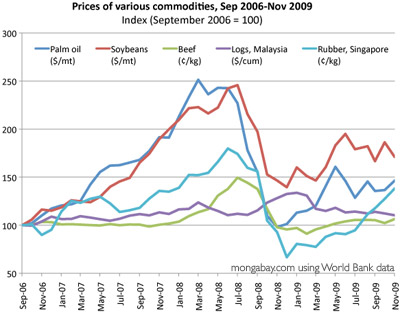
- Starting with Brazil, with its lowest deforestation rate since at least 1980, global deforestation has fallen to its lowest level in just over 10 years. The main reason is the international economic crisis, which has dried up funding for forest destruction and contributed to a collapse in the prices of basic goods, a factor at the root of deforestation.
- 2009 was also significant for the progress made on REDD, a proposed mechanism for mitigating climate change that would provide financial assistance to tropical countries to protect their forests.
- Throughout the year, business and political leaders, prominent scientists and conservation groups, celebrities, and other prominent figures expressed their support for REDD.
- This enthusiasm extended to the climate talks in Copenhagen, where REDD was one of the few projects to receive funding. Questions about REDD now center mostly on the details of the mechanism, such as implementation, financing, oversight, and venture capital, rather than focusing on basic concepts such as protecting rainforests as a means of reducing greenhouse gas emissions.
Factors of deforestation.
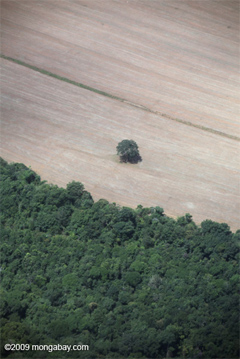 Deforestation in Mato Grosso. Photo by Rhett A. Butler. |
- The progress made in 2009 is due to a shift in the drivers of deforestation. There has been a shift from clearing forests for survival to organized destruction directed by large companies. This trend has accelerated with urbanization and governments' abandonment of colonization projects. Corporations and large landowners have growing resources for deforestation, but they are also easy targets for pressure groups. It is easier for pressure groups to blame big business and corporations for forest destruction than the millions of poor farmers simply trying to survive. Consequently, the major industrial drivers of deforestation—the palm oil, cattle ranching, and logging industries—were heavily targeted by activist campaigns in 2009.
- In Brazil, the cattle industry was slammed by a Greenpeace report linking some of the world's most recognizable brands—Nike, Toyota, Prada, and others—to the destruction of the Amazon rainforest.
- The reaction to this report was immediate. Some of the largest buyers of beef and leather canceled their contracts with suppliers implicated in the destruction of the Amazon rainforest.
- The Brazilian government announced preventative measures and fines, raided the offices of major cattle companies, and reviewed funding programs. Government ministers joined the private sector in demanding new product sourcing controls for suppliers to ensure livestock products do not contribute to deforestation. Major cattle producers and traders swiftly responded with a moratorium on Amazon forest clearing and a promise to implement more effective supply chain controls.
- The Brazilian cattle industry could transform from a major contributor to deforestation into an indispensable component in driving slow climate change.
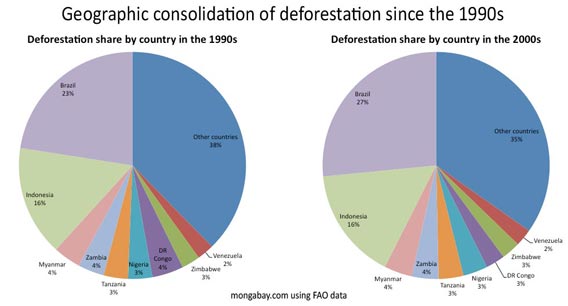 Since 1990, deforestation has become increasingly concentrated. Recent research published by Matt Hansen of the University of South Dakota indicates an even more dramatic shift in recent years. His work, based on high-resolution satellite imagery, shows that Brazil and Indonesia accounted for 61 percent of tropical forest destruction between 2000 and 2005, rather than the 43 percent reported by the FAO. |
- In Southeast Asia, the palm oil industry has been hit by a decision by Unilever, the world's largest palm oil buyer, to suspend its contract with Sinar Mas, the world's second-largest palm oil producer.
- This decision followed an investigation commissioned by Unilever, which proved Greenpeace's allegations about the palm oil producer's environmental records to be true.
- The investigation's findings have slowed the progress of the Roundtable on Sustainable Palm Oil (RSPO), of which Sinar Mas is a member (although its activities have not yet been found environmentally responsible).
- Some other major palm oil buyers, such as Cadbury New Zealand and Lush Cosmetics, have announced they will suspend the use of palm oil in their products due to consumer concerns about deforestation.
- Meanwhile, an internal investigation conducted by the World Bank, the International Finance Corporation, concluded that it violated its own environmental rules by granting loans to palm oil companies.
- Two companies announced they would forgo concessions in carbon-rich areas, thus preserving the land's forests, in exchange for payments.
 |
- In the forestry sector, several large companies have severed ties with timber, pulp, and paper companies linked to illicit activities in Indonesia, as reported by NGOs.
- The US and Europe have strengthened enforcement of laws and regulations (the Lacey Act in the US and FLEGT in Europe) to enforce environmental protection laws on importers in timber-producing countries. In Brazil, federal authorities have opened an investigation into the illegal export of timber in the state of Pará. The timber was disguised as "eco-certified" and exported to markets in the US, Europe, and Asia.
- In China, the Ministry of Environmental Protection has drafted a bill that would require Chinese companies operating abroad to comply with the environmental laws of China and the host country. It is not yet clear whether these laws will come into force.
More good news
- 2009 was also a significant year for other advances in tropical forests.
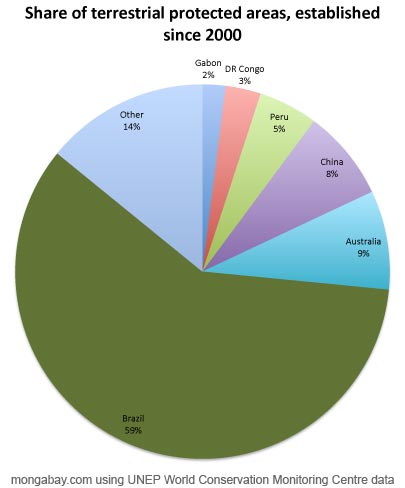
- Brazil, Peru, and the Democratic Republic of Congo created large tropical parks, while Papua New Guinea established its first nature reserve.
- Norway continues to lead industrialized countries in financially supporting the protection of the Amazon rainforest, donating $250 million to Guyana and renewing its pledge of $1 trillion to Brazil.
- The United States, Japan, Australia, France, and Great Britain have also made significant financial commitments to the Amazon rainforest.
Deforested area and intact forest in Borneo |
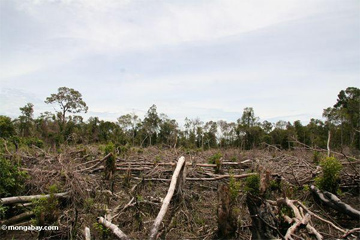
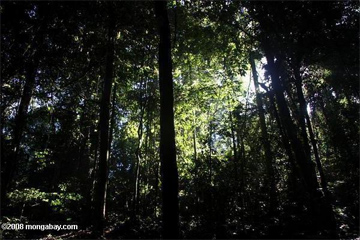
- Indigenous rights in Brazil have received a boost thanks to a court victory in a dispute with ranchers in Roraima and a legal opinion that the Surui tribe has carbon rights on their land. This could perhaps one day lead to projects related to forest carbon management by the indigenous people themselves.
- The Surui also revealed their partnership with Google to develop tools that will allow the tribe to protect their lands from encroachment by loggers, miners, and ranchers.
- Collaborating with leading scientific bodies and NGOs, Google has created the "Earth Engine" platform, a system that combines computer power with advanced monitoring and analysis technologies.
- The platform should enable high-resolution, real-time monitoring of forests and carbon in selected areas worldwide before 2011.
- At the same time, the Woods Hole Research Institute has perfected a high-definition global forest map to track land changes.
- But the good news for tropical forests has been undermined by developments such as Indonesia ceding more than two million hectares of carbon-rich wetlands to palm oil development; the collapse of regulatory measures in Madagascar, leading to indiscriminate logging (and lemurs) in the country's spectacular tropical parks; a halt to an RSPO meeting on efforts to reduce greenhouse gas emissions from palm oil production; violent conflicts in Peru between government security forces and indigenous groups over land rights and resource extraction; massive foreign land acquisitions in the Congo Basin; suspicious REDD relationships in Indonesia and Papua New Guinea; and large-scale expansions of palm oil cultivation in the Amazon.
- Brazil has granted amnesty to farmers and ranchers who have illegally occupied or cleared land in the Amazon rainforest, a decision that somewhat legitimizes past deforestation (others believe this is an important step toward better management in the region).
Looking to the future
|
While the progress made in 2009 appears to have long-term implications for environmental protection, the fate of tropical forests is still far from certain.
Looking ahead, issues to watch include: the impact of economic recovery on commodity prices and agricultural expansion for food and biofuel production; large-scale land acquisitions by foreign countries and corporations in tropical countries; climate negotiations and the REDD mechanism, including disputes over land rights, competing definitions of forest, and sustainable forest management; the emergence of payments for ecosystem services behind REDD; price capping and trading versus carbon taxes; efforts to address demand by accounting for deforestation—significant consumption; emerging certification systems for agricultural and forestry products (e.g., RSPO, Aliança de Terra, FSC, etc.); and Brazil's progress in achieving its goal of reducing deforestation.
Post a Comment