A Hope for Survival: Two Isolated Groups of Orangutans Reunited by a Rope Bridge
- Researchers in the Malaysian state of Sabah, Borneo, are thrilled after receiving confirmation that a young male orangutan used a rope bridge to cross the river separating one orangutan population from another. Due to logging and forest clearing for oil palm plantations, which cover 18% of Sabah's land, orangutans in the Kinabantangan River have been reduced to fragmented populations.
- “We have received several eyewitness reports of orangutans using these rope bridges over the years, but this is the first time we have received photographic evidence that clearly shows a young male orangutan using the first rope bridge we built in 2003 to cross the Resang River, a small tributary of the Kinabatangan,” primatologist Dr. Isabelle Lackman, co-director of the Kinabatangan Orangutan Conservation Project (KOCP), explained in a press release.
- The photos of the male orangutan using the rope bridge were taken by Ajirun Osman, who says the orangutan crossed the rope bridge after standing still for twenty minutes: “It was as if he just decided to cross, and he did so very quickly, arriving from the Pangi Forest Reserve to the first lot of the Kinabatangan Nature Reserve in about three minutes.”
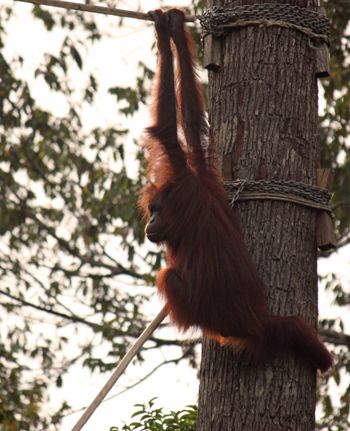 The young male orang-utan begins his journey across the Resang River, a tributary of the Kinabatangan along a rope bridge constructed in 2003 by the Sabah Wildlife Department and Kinabatangan Orang-utan Conservation Project. Photo by: Ajiran Osman @ Aji. |
- Before the area was deforested, orangutans used the canopies of branches and leaves created by the trees in the old-growth forest, which allowed them to easily cross the small rivers. For this reason, researchers decided to build artificial bridges to allow the fragmented populations to stay in touch. So far, six bridges have been built by KOCP, as part of an initiative in collaboration with the French NGO HUTAN.
- "The use of rope bridges is a temporary solution; the best solution would be to reconnect the forest, and we are working towards this. And when I say 'we are,' I mean everyone, from the government sector to environmental NGOs and, most importantly, the palm oil industry," says veterinarian Dr. Marc Ancrenaz, who is also co-director of KOCP.
- A recent survey conducted by the Sabah Department of Wildlife Conservation and the KOPC found that 1,000 orangutans inhabit the Kinabatangan River downstream, in both protected and unprotected areas. According to genetic studies conducted by the Sabah Department of Wildlife Conservation, the KOPC, Cardiff University, and the Danau Girang Field Centre, these populations are estimated to be extinct within a generation if they are not reunited through solutions such as rope bridges.
- “Today, orangutans face many more human-caused obstacles, such as illegal oil palm cultivation along the riverbanks, which leaves no room for riparian reserves, which are legally required under the Environment Protection Enactment of 2002 and the Water Resources Enactment of 1998,” Lackman says.
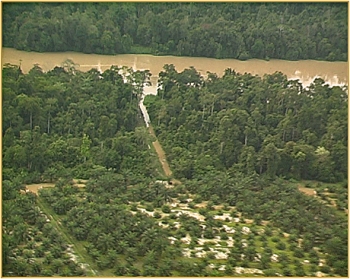 : An example of an illegal drain built by oil palm plantations to help drain their crop. Such drains create obstacles for orangutans and other wildlife which are unable to cross over to the other side. The orangutan rope bridge built by the Sabah Wildlife Department and the Kinabatangan Orang-utan Conservation Project act as a “quick fix” but ultimately forest corridors are needed to link forest for wildlife survival. |
- “Although it will be a long and costly process, reuniting the isolated populations that were originally united will ensure the long-term survival not only of Sabah’s orangutans, but also of other unique species, such as the Bornean pygmy elephant, sun bear, clouded leopard, and many others,” added Dr. Laurentius Ambu, director of Sabah’s Department of Wildlife Conservation.
- Last fall, participants at a conference in Sabah, including the Sabah Department of Environmental Protection, NGOs like HUTAN, and palm oil producers, committed to creating wildlife corridors to safeguard the orangutan population and other endangered species. The agreement includes land acquisition along rivers, such as the Kinabantangan, and connecting forest areas.
- During the conference, Tan Sri Bernard Dompok, the Minister of Plantation and Commodity Industries, addressed the press, saying, “I will support the effort to create a corridor and expropriate land so as to make our country's agriculture and tourism industry sustainable.”
- The Bornean orangutan is currently classified as endangered on the IUCN (International Union for Conservation of Nature) Red List, while its southern relative, the Sumatran orangutan, is considered critically endangered. The state of Sabah supports approximately 11,000 Bornean orangutans.
Post a Comment