- A group of Brazilian lawmakers, known as “ruralistas,” are working to change key aspects of the landmark 1965 Forestry Code. This would weaken protections for the Amazon and the Mata Blanca (also known as the Atlantic Forest) and trigger a new surge in deforestation.
- Ruralists, linked to landowners and large agricultural companies, have targeted the section of the Forestry Code that requires landowners in the Amazon to set aside 80% of their holdings as reserves, arguing that this law threatens agricultural development.
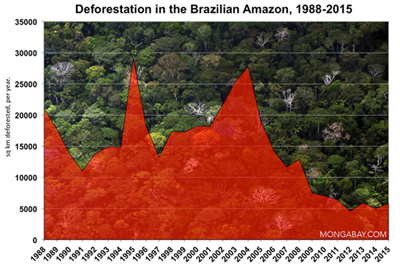
- The legislature also proposed changes to the "Permanent Protection Areas" section of the Code, which identifies areas of virgin forest to be protected, including riverbanks, slopes, and hilltops. Ruralists want this section of the Code to be regulated at state level rather than federal level, thus allowing individual states to halve these areas if they deem appropriate. WWF-Brazil maintains that if these changes were to pass, deforestation could reach levels similar to those of the 1980s.
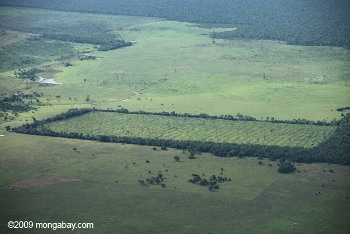
Forest reserve in Mato Grosso, Brazil. An unintended consequence of the change to the Forest Code could be the creation of financial incentives for farmers and ranchers to protect forests. For example, if a state requires 50% of its land to be protected, the excess land could qualify for funds to reduce CO2 emissions, in addition to compensation from maintaining Permanent Protection Areas. Currently, the incentives for maintaining these areas are negligible, and the risk of legal consequences is almost nil. Consequently, the 80% threshold is almost completely ignored. Photo by Rhett A. Butler.- "The debate should be based on science, not on distorted and unclear arguments," says Carlos Alberti de Mattos Scaramuzza, Director of the Conservation Section at WWF Brazil, in an article . "Instead, the scientific community played a marginal role in drafting this document."
- Ruralists, for their part, argue that environmental NGOs are allying with foreign governments to undermine the authority of the Brazilian government.
- "Uncomfortable with their petty ambitions, wealthy nations use the long arm of NGOs, which arrive in Brazil as bearers of good news in defense of nature, but are incapable of hiding the true cause behind their efforts: the interests of the nations where they are based and from which they receive their enormous funds," writes Aldo Rebelo, a Communist Party member of parliament, in a statement on the need for change. This conspiracy theory of foreign governments has, however, been widely discredited, both in Brazil and abroad.
- The Forest Code, which is certainly not the best forest conservation law in the world, is supposed to protect more than 100 million hectares. However, it is often ignored and rarely enforced: illegal deforestation has reduced the amount of protected hectares by 40%. However, even if it is not rigorously enforced, the Forest Code is still considered one of the most important tools that have contributed to the decline in deforestation in Brazil.
- Another proposal from the rurales is an amnesty for those who have illegally cleared protected lands. According to WWF Brazil, this amounts to approximately 43 million hectares, equivalent to 14.6 billion tons of greenhouse gases.
- The vote is expected to take place next week: approval of the changes would jeopardize Brazil's achievement of its deforestation and greenhouse gas reduction targets. The Brazilian government has ambitiously committed to reducing deforestation by approximately 70% compared to 1996-2005 levels and, consequently, greenhouse gas emissions by approximately 5 billion tons by 2018.
- WWF-Brazil also argues that Brazilian farmers and ranchers do not need to continue deforesting to increase production. The organization cites a report by the University of São Paulo (USP/ESALQ) showing that the impact of Permanent Protection Areas on agricultural production is only 1 percent. Environmental organizations argue that farmers and ranchers can significantly increase yields by increasing productivity rather than further deforestation.
- “The law, if approved, would represent a serious step backwards in forest policy and protection,” Sergio Abranches, co-founder of the Brazilian environmental website O-Eco , told mongabay.com. “All things considered, it is unlikely that a final vote will be held before the end of the year. After the elections [in October], there will likely be a more objective and scientific discussion on how to update the Forest Code and how to reconcile forest protection and agricultural production.”
- A report released last week by the American group Avoided Deforestation Partners (ADP) and the National Farmers Association has further fueled the political debate. According to this report, if deforestation slowed, or even stopped, in countries like Brazil, rising commodity prices would lead to a boom in US farmers' incomes (between $141 and $221 billion between 2012 and 2030). Ruralists have used this report to defend the forestry law, viewing it as evidence of foreign interference. However, ADP and the National Farmers Association have released a second report stating that Brazilian farmers would also see their incomes increase thanks to rising prices and funding for reducing carbon emissions and protecting forests.
- Such a rise, however, could increase poverty and hunger worldwide. Sudden spikes could cause food crises like the one in 2006, when millions of people were in extreme hunger and poverty. The United Nations estimates that, currently, one million people worldwide do not have enough food, even though global agriculture is producing enough for everyone.
Tuesday, August 12, 2025
Amazon and Atlantic Forests in danger
Similar Posts
Subscribe to:
Post Comments (Atom)
Post a Comment