- If someone saves your life, you try to express your gratitude in every way: with a gesture, a "thank you," or by returning the favor in some way. But things are decidedly more complicated when you owe your life to a plant thousands of miles away.
- As a nurse, I'd known for years that many lifesaving medications are derived from plants and animals from all over the world. I never imagined, however, that one day I'd have to rely on the bark of a rare Asian tree for survival.
- Nine years ago, I was diagnosed with appendiceal cancer and given only months to live. As a mother of two, I couldn't accept that prognosis at the time. Luckily, I met a doctor who wanted to help me fight: I underwent major abdominal surgery and months of chemotherapy.
- I'm now cured, mainly thanks to irinotecan, a drug that helps block the growth of cancer cells. The active ingredient in this drug is extracted from a tree with banana-shaped pods found only in China and Tibet, aptly called the "Chinese tree of happiness" (Camptotheca). However, this tree and many other potential sources of treatment may soon disappear as they are threatened with extinction.
- I have lived many years beyond my expected life expectancy, and many others like me are alive and well thanks to other medications derived from natural sources: from cholesterol-lowering drugs to antimalarials.
- However, around the world, many of the wild areas that are home to plants and animals that are potential sources of numerous new medicines are disappearing. A forest razed to the ground in what may seem like a remote corner of the earth can have crucial consequences for someone living here in the United States.
- Plants can't move to escape danger. That's why they deploy a complex chemical arsenal to protect themselves from insects, diseases, and any other threat. Many of these chemical compounds, in addition to protecting plants, can potentially protect us humans as well. In fact, half of the drugs developed in the last 25 years, and 70 percent of the drugs currently used for cancer treatment, are derived from nature.
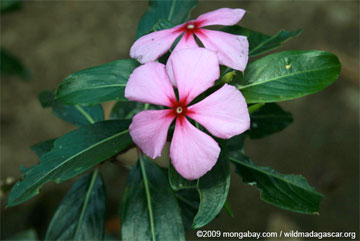 Madagascar periwinkle rose. Photo by Rhett A. Butler 2009 |
- To create a new HIV drug, scientists extracted chemical compounds from a plant native to Western Samoa. Vinblastine and vincristine, which treat leukemia and lymphoma, are extracted from the periwinkle rose, native to Madagascar. And there are hundreds of other examples like these.
- Drugs can also be obtained from many animal species, some of which are threatened with extinction. For example, exenatide, a diabetes drug marketed under the name "Byetta," is synthesized from a compound found in the saliva of Heloderma suspectum (or Gila monster), a lizard native to Mexico. Heart transplant recipients often take lisinopril, derived from the venom of a Brazilian rattlesnake.
- However, it's possible that within forty years, the habitats of these plants and animals will disappear. We lose 13 million hectares of forest every year (an area the size of Greece). Scientists estimate that two-thirds of all species could become threatened with extinction by the end of this century. However, researchers have only been able to examine 1 percent of rainforest plants for organic compounds that could benefit human health. If we don't act quickly, we could forever lose natural resources that can treat cancer, arthritis, HIV, diabetes, heart disease, and countless other ailments.
- Most species are found in the poorest nations on earth. That's why last month, along with other cancer survivors from across the United States, I traveled to Washington to support a new congressional initiative aimed at strengthening U.S. conservation efforts internationally. The Global Conservation Act, introduced early this spring, would establish a national strategy to help the government protect natural areas in developing countries, which are too poor to do so alone.
- I'm grateful for the "Chinese Tree of Happiness" because it helped save my life and allowed me to watch my two daughters grow up. Speaking out for nature, and all the medical treatments it offers us, is simply my way of saying "thank you."
- Carolyn Langlie-Lesnik is a registered nurse and nine-year appendiceal cancer survivor. She is the founder and editor of the website " The Appendix Cancer Connection ." She lives in Crown Park, Indiana, and works with cancer survivors to promote the connection between international environmental protection and the treatment of life-threatening diseases.
Post a Comment