- From 2000 to 2005, the world lost over a million square kilometers of forest.
- According to a new study published in the Proceedings of the National Academy of Sciences (PNAS), global forests continue to decline. Using satellite imagery, researchers found that between 2000 and 2005, over one million square kilometers of forests were lost worldwide. This represents a 3.1 percent decline compared to the total forest cover calculated in 2000. The study does not take into account forest gains during the same period, but it does reveal some surprising data regarding the actual locations and amounts of forests lost: most notably, the fact that from 2000 to 2005, both the United States and Canada had a higher rate of deforestation than even Brazil.
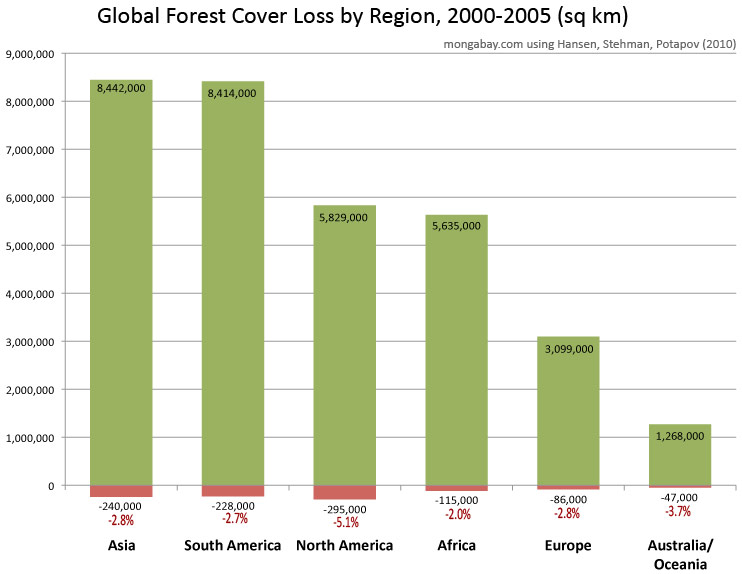
- Considering deforestation due to both human intervention and natural causes, the study showed that North America has lost the greatest amount of forest of all the other forested continents. Remarkably, 30 percent of the total forest loss occurred in North America. When South America—the world's largest tropical forest area—is included, the two continents account for half of the total global forest loss. Africa, in turn, has suffered the least loss.
- Forest loss by nation
 Global forest cover loss by biome, 2000–2005. Table by Rhett A. Butler / mongabay.com. Click to enlarge. |
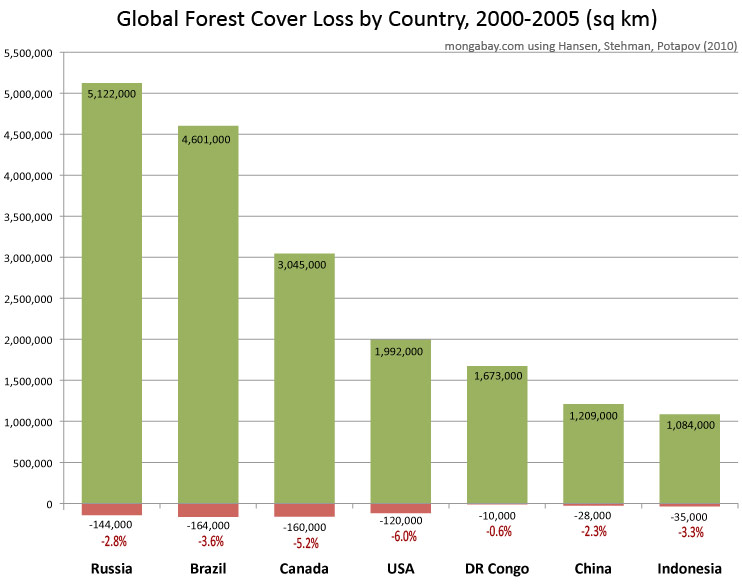
- Of the seven nations with more than one million square kilometers of forest – Russia, the United States, Canada, Indonesia, China, and the Democratic Republic of the Congo – the country that lost the greatest total amount of forest over the past five years was Brazil.
- According to the researchers, Brazil lost 26,000 square kilometers (10,038 square miles) of its rainforests annually, and 7,000 square kilometers (2,702 square miles) of its tropical forests. Over the five years, Brazil's total forest loss reached 165,000 square kilometers (63,706 square miles). Overall, this represents 3.6 percent of its total forest area in 2000—half a percentage point higher than the global average. However, the study does not include small-scale logging or forest degradation in places like Brazil unless tree cover falls below 25 percent.
- Canada was right behind Brazil, losing some 160,000 square kilometers (61,776 square miles) of its forest cover. Canada's deforestation, proportionately, represents 5.2 percent of its total forest area—more than Brazil's rate and more than two points higher than the global rate.
- But the United States had the highest rate of loss of the seven nations—even higher than Brazil and Canada—losing 6 percent of its forest cover in just five years, a total of 120,000 square kilometers (46,332 square miles). While wildfires and beetle infestations played a major role in Alaska and the western United States, in the Southeast, along the West Coast, and in the Midwest, national deforestation was primarily driven by logging industries.
- "This doesn't mean forests aren't regenerating, and we're absolutely not making claims about renewability," lead author Matthew Hanse explained to USA Today. "But compared to other regions of the world, something is happening."
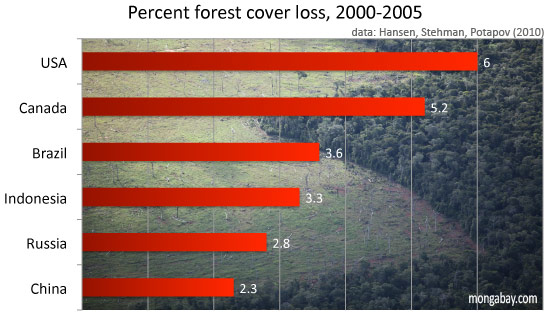 Percentage of forest cover loss by major country, 2000–2005. Butler / mongabay.com. Click to enlarge. |
- The researchers state that "forest conversion was observed in our data in regions between the tropics, but significant GFCL [i.e., global forest cover loss] is evident across all biomes. For example, GFCL rates in regions such as the southeastern United States are among the highest globally."
- Of the other seven nations: Indonesia lost 3.6 percent of its forests over the five years, Russia 2.8 percent, while the Democratic Republic of the Congo lost the smallest percentage: 0.6 percent.
- The study also highlights other countries with significant forest loss: Malaysia due to oil palm plantations, Paraguay and Argentina due to agriculture, and Australia due to fires.
Deforestation by ecosystem
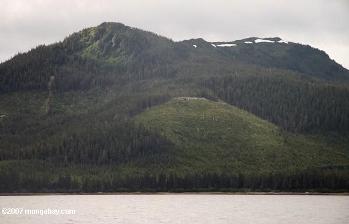 Deforestation in Alaska. Photo: Rhett A. Butler. |
- Comparing the four major forest ecosystems, the study shows that the boreal ecosystem suffered the greatest loss over the five-year period, followed by tropical rainforests, tropical dry forests, and finally temperate forests.
- In the boreal ecosystem, 60 percent of the loss was caused by fires, while the remaining 40 percent was caused by logging, disease, and mountain pine beetle infestations related to climate change.
- For tropical rainforests, most of the loss occurred due to conversion to agriculture in Brazil and plantations in Indonesia and Malaysia. For the Congo Basin, the report showed that large-scale deforestation for agricultural land can be considered one of the causes of the country's forest decline.
- In Brazil, Paraguay and Argentina, dry tropical forests have been extensively cleared to make way for agricultural land.
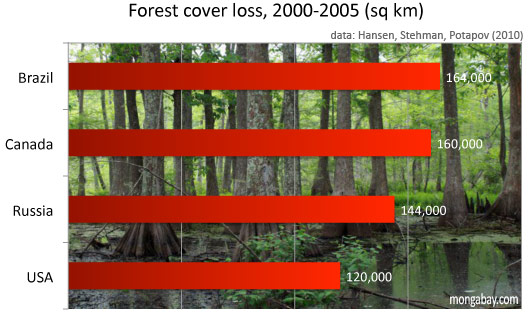 Total forest loss (natural causes or deforestation) for the United States, China, Brazil, and Russia, 2000–2005. Table by Rhett A. Butler / mongabay.com. Click to enlarge. |
Temperate forests have suffered the least amount of total loss because, as the researchers argue, "most of this biome has long been converted to agricultural and settlement land." However, proportionally, temperate forests come in second place of the four forest types due to the high rate of forest loss recorded in the United States.
In measuring forest loss, the study calculated forest area as 25 percent tree cover with trees taller than five meters.
CITATION: Hansen, Matthew C.; Stehman, Stephen V.; and Potapov, Peter V. Quantification of global gross forest cover loss. PNAS. www.pnas.org/cgi/doi/10.1073/pnas.0912668107.
Global forest cover loss by country, 2000-2005. Chart by Rhett A. Butler / mongabay.com. Click to enlarge.
Post a Comment